Written by the Together with Kai team · October 13, 2026
New in the feed
Five Ways to Tell the Truth About Yourself
Bio lines are usually who we hope to be on our best days. The quick choices we make when nobody is looking are who we actually are.
Every social app starts with the same clumsy question: tell us about yourself.
So we try. We pick three adjectives, quote a book we read three years ago, upload a photo where the lighting was unusually forgiving, and list our hobbies as if filling out a polite customs declaration. It is exhausting, and worse, it rarely works. You cannot summarize a human being in a paragraph, because people don’t experience each other as resumes. We experience each other in moments—how someone handles a delay, what they notice first in an empty room, and where they draw the line when things get uncomfortable.
That is why we built our daily games differently.
No trivia, no leaderboards, and no points to hoard. Just five questions each day, designed not to test your knowledge, but to catch your instincts in motion. Five questions later, Kai introduces you to someone whose inner compass points in the same direction as yours.
Here is how the five games work, and what they reveal.
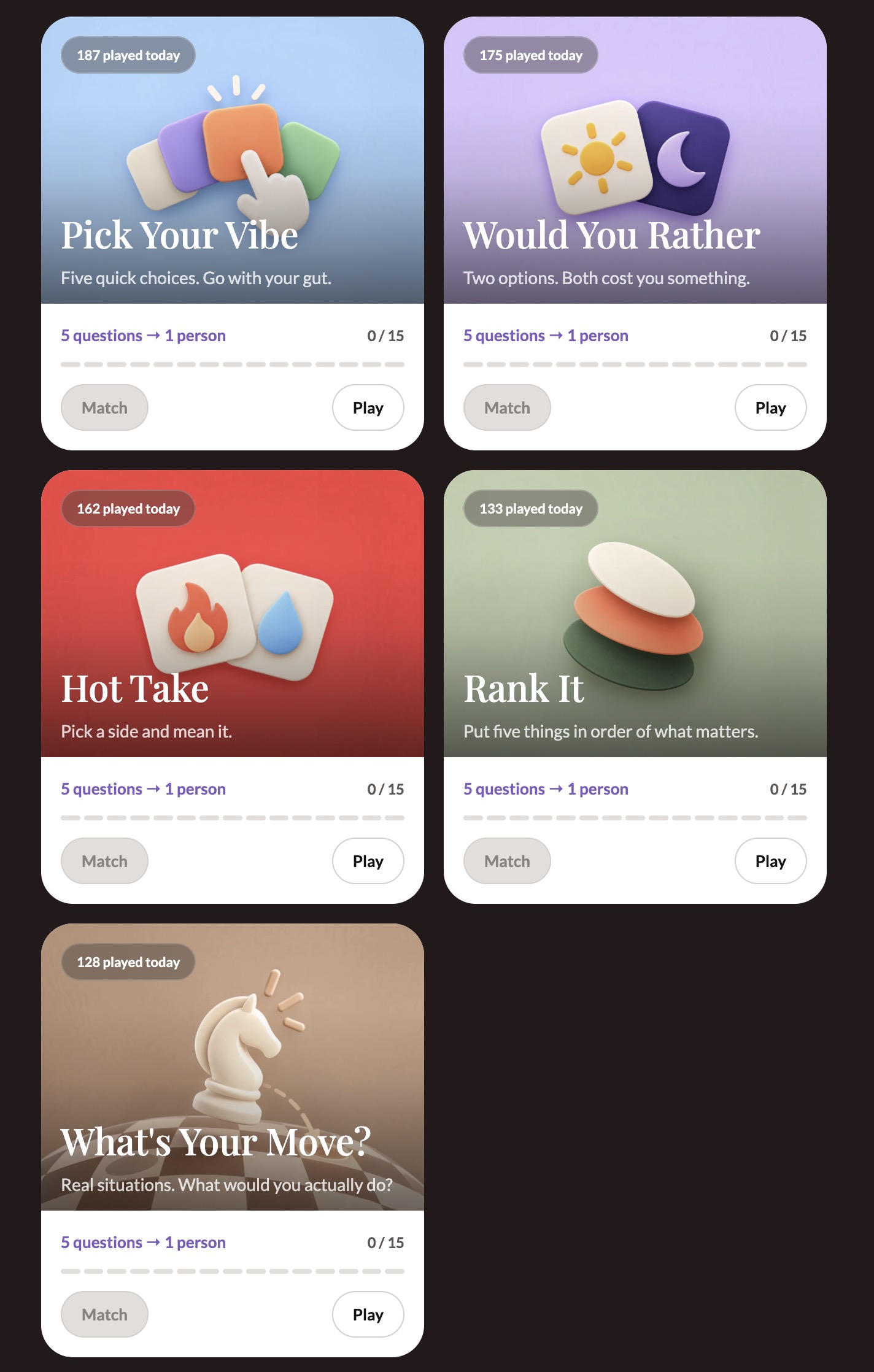
1 · 5 questions → 1 person
Pick Your Vibe
Five quick choices, go with your gut.
Overthinking is the enemy of honesty. When we have too much time to deliberate, our social filters take over: we choose the answer that sounds cultured, composed, or relaxed.
Pick Your Vibe gives you five rapid-fire pairs or prompts and asks for an immediate pulse check. Do you take in the celebration from the edge of the room, or do you dive straight into the middle? When the city lights flicker at midnight, are you ready to pack it up while it’s still golden, or are you looking for the one place still open?
There are no wrong answers and no hidden scoring rubric. It’s simply the rhythm of how you move through an ordinary day. When you see someone who made the exact five instinctual choices you did, you don’t need an icebreaker. You already know how they take their mornings.
2 · 5 questions → 1 person
Would You Rather
Two options, and both cost you something.
Most party versions of this game are silly: would you rather have feet for hands or hands for feet?
On Kai, Would You Rather is about friction and tradeoff. Anyone can choose between something great and something terrible. Real character shows up when you have to choose between two good things you cannot have together, or two small discomforts you have to endure.
Plan the perfect night from start to finish, or surrender completely to wherever the evening drifts? Keep a tender memory entirely to yourself, or risk sharing it with someone who might not understand? When both options ask you to give something up, your pick tells the truth about what you value most—certainty or spontaneity, safety or vulnerability.
When you match with someone here, you don't just share a preference. You share a sacrifice.
3 · 5 questions → 1 person
Hot Take
Pick a side and mean it.
Politeness is wonderful for grocery store checkout lines, but it makes for dull conversations. Too often in modern life, we sand down our edges to avoid offending anyone, until everything we say sounds like corporate PR.
Hot Take takes away the safe middle ground. There is no “it depends,” no sliding scale, and no diplomatic shrug. A premise appears on screen, and you have to plant your flag: Agree or Disagree.
It isn't about cruelty or outrage bait—Kai is a zero-bullying community and always will be. It’s about taste, convictions, and the small, stubborn hills you are secretly willing to die on. Finding someone who disagrees with you with equal passion can spark the best debate of your week. Finding someone who shares your exact contrarian belief feels like finding an accomplice in a crowded room.
4 · 5 questions → 1 person
Rank It
Put five things in order of what matters.
If someone asks you what matters in a friendship, you will probably say trust, humor, loyalty, presence, and kindness. And you would be right. But what happens when you have to stack them?
Rank It lays out five elements of a situation—the timing, the surprise, the kindness, the memory, the person—and asks you to order them from top to bottom. Dragging one above the other forces an internal audit. Is a shared history more important than how someone shows up today? Does the music matter more than the conversation?
Looking at someone else's order is fascinating because it shows you their hierarchy of meaning. It tells you what they notice first and what they are willing to forgive. It turns an abstract question into a clear portrait of priority.
5 · 5 questions → 1 person
What's Your Move?
Real situations, and what you would actually do.
Theory is easy. Reality is messy.
What's Your Move? drops you into an actual scenario. The dinner party died an hour ago, but the host just opened another bottle. An old friend calls out of nowhere with an urgent question they clearly rehearsed. The conversation in the circle took an awkward turn and everyone is looking at the floor. What do you do right now?
Not what you ought to do according to an etiquette book. What do you actually reach for? Do you crack a joke to relieve the tension? Do you step in and change the subject? Do you let the silence sit until it resolves itself?
How we act when plans slip reveals how we handle life. Matching with someone who shares your instinct in a crisis—or someone whose move perfectly balances yours—is where genuine camaraderie begins.
The Match at the End
When you finish five questions, you don’t get a badge or a score to post to a feed. You get something far rarer: an introduction.
Kai pairs you with another member who answered those exact questions today. You don't have to scramble for something clever to say. You already have five real moments of shared intuition sitting right in front of you.
Five questions. One minute. One person who sees the world a little like you do.