
Two people are awake at midnight. Neither knows the other exists. Both open the same app, and both press the same button, which says they would like to talk to someone.
They get matched. The call connects. Both faces appear.
The middle conversation lasts eleven seconds.
That is the median across 152,939 matches on our platform. Not the worst case. The middle. Half of all connections between two people who explicitly asked to be connected end faster than it takes to read this page.
We think that eleven seconds is the most important unstudied number in the loneliness crisis, and this report is about what sits around it.
Why this data does not exist anywhere else
Almost everything published about loneliness comes from surveys. A survey asks people how lonely they feel, on a scale, after the fact.
This is different. This is what people actually did at the moment they tried to stop being lonely, captured while they were trying.
Kai is a platform where people talk to an AI companion, join spaces, post to a feed, get matched into one to one calls with strangers, and message each other. It has been running since December 2025, mostly in India. Everything below comes from the production database as of 7 September 2026:
- 89,839 registered people
- 449,590 messages sent to the AI companion
- 832,098 direct messages between people
- 152,941 one to one match attempts
- 572,256 structured observations extracted from conversations
- 59,502 private message threads
Every figure is an aggregate. No message content was read, quoted or reconstructed. No individual appears anywhere in this analysis. Nobody's story is here. Only the shapes that thousands of stories make when you stand far enough back.
Finding 1: Loneliness almost never calls itself loneliness
Every day, the system takes a reading of a person's emotional state and picks the dominant emotions from that day's conversation. Across 15,202 of those daily readings:
| Emotion | Days it was dominant | People |
|---|---|---|
| Sad | 3,796 | 2,963 |
| Joy | 1,347 | 967 |
| Hope | 963 | 722 |
| Fear | 568 | 441 |
| Frustrated | 433 | 366 |
| Trust | 277 | 223 |
| Anxious | 225 | 188 |
| Lonely | 33 | 28 |
Sadness runs about three to one against joy. That part is expected on a platform people come to when something is wrong. The row that matters is the last one. Across more than fifteen thousand daily emotional readings, "lonely" was the leading emotion thirty three times. Two tenths of one percent. It is not that loneliness is absent. Look for the words "lonely," "loneliness" and "alone" anywhere in what people said, and they attach to 2,500 out of 32,735 people, roughly one in thirteen. Loneliness is in the conversation constantly. It is simply never the headline. It arrives as sadness. As fear. As frustration, tiredness, boredom, a flat week. People describe the shape of a life without enough people in it, and they use every word except the one on the survey. What this means in practice: loneliness does not present as an emotion you can name and act on. It presents as everything else being slightly worse. Any service that waits for someone to say "I am lonely" is going to wait a very long time, because that sentence is almost never spoken. You have to read it in the negative space.
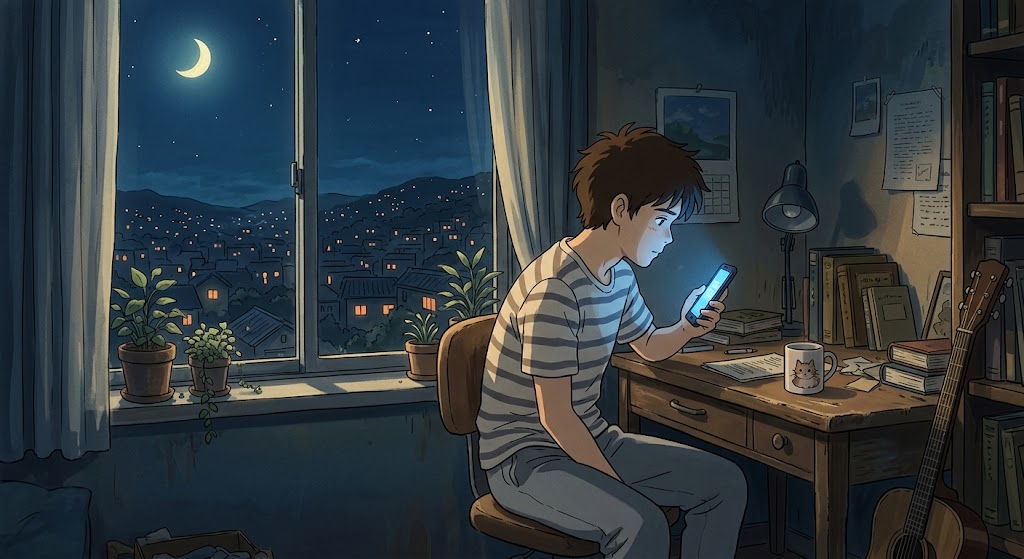
Finding 2: Connection has an hour, and it is eleven at night
Message volume by hour, Indian Standard Time, across the last 90 days:
| Hour | Share of all messages |
|---|---|
| 23:00 | 10.25% |
| 00:00 | 8.37% |
| 22:00 | 8.21% |
| 21:00 | 6.43% |
| 01:00 | 6.14% |
| 06:00 | .69% |
Thirty seven percent of everything that happens, happens in the five hours between ten at night and two in the morning. The peak hour carries fifteen times the traffic of six in the morning. We tested the obvious explanation first, which is that people confide in an AI at night when nobody is awake. If that were the story, AI conversation would be more nocturnal than everything else on the platform. It is not. The AI, the feed, the spaces and the calls all follow the same curve, within a few percent of each other at every hour of the day. So the finding is broader and stranger than a confession hour. The whole thing is a night phenomenon. Reaching out is something people do in the dark, whatever form the reaching takes. Daytime barely registers. Anyone building a service for lonely people should notice that the entire demand curve sits in the hours when almost every support service in the world is closed.
Finding 3: Seven in ten conversations are one person talking to nobody
Of 59,502 private message threads on the platform:
- 69.1% contain messages from only one person. The other side never replies.
- Median messages in a thread: 2.
- Only 16.1% ever reach ten messages.
- Only 4.7% ever reach fifty.
Read the first line again. Someone found the nerve to write to a stranger. They chose the words, sent it, and waited. Seven times out of ten, nothing came back.
This is what no survey can reach. Nobody reports "I sent a message and was ignored" on a loneliness scale, because it does not feel like an event. It feels like a small nothing, and then another small nothing.
But operationally, that is what loneliness is. Not the absence of people. The absence of reply.
The gap between "there are people here" and "someone answered me" turns out to be the entire distance.
Finding 4: The first sixty seconds decide everything
Now back to the eleven seconds, with the full picture.
Of 152,939 attempts to put two strangers together:
- 95.6% had both people arrive
- 82.2% connected successfully
- Median conversation: 11.3 seconds
- Reached one minute: 8.8%
- Reached five minutes: 2.2%
Notice what is not failing. People show up. The connection works. Both faces appear. Then, in about ten seconds, one of them decides no.
Look at how conversations end and the picture gets clearer. 71.3% end because somebody simply hung up, at a median of 10.5 seconds. Another 16.3% end because the other person left first, at 12.9 seconds. Almost nothing is technical. It is two humans looking at each other and making a very fast judgment.
We have all made that judgment. The interesting question is what happens when people get past it.
Finding 5: One real conversation beats a dozen attempts
This is the finding that reframes everything above.
We asked: who ends up with an actual ongoing relationship, meaning a two sided thread of ten or more messages? And does having had one long conversation predict it?
People who have long conversations also tend to have many conversations, so we split by volume and looked inside each band:
| Total conversations attempted | Never got past five minutes | Had at least one five minute conversation |
|---|---|---|
| 1 to 2 | 5.7% | 25.1% |
| 3 to 5 | 7.3% | 31.2% |
| 6 to 15 | 15.5% | 42.7% |
| 16 to 40 | 33.6% | 50.0% |
| 41 or more | 51.7% | 79.9% |
The effect holds at every level. It is largest where attempts are fewest. And then the comparison that matters: A person who tried once or twice, and had one conversation reach five minutes, ends up with a real relationship more often (25.1%) than a person who tried six to fifteen times and never got past five minutes (15.5%). One good conversation beats a dozen brief ones by more than half again. This is the most hopeful thing in the dataset. The problem is not that lonely people cannot form relationships. It is not that there are not enough people, or that the matching is wrong, or that the appetite is missing. Ninety six percent of the time, both people show up. The problem is concentrated almost entirely in the first minute, and it appears to be solvable by getting people through that minute rather than by giving them more chances to fail it. One honest note. This is an observed pattern, not a proven cause. It is possible that people who can sustain five minutes are simply people who can sustain relationships, and the long conversation is a symptom rather than the mechanism. The way to settle it is an experiment, and we are running one.
Finding 6: The people who want connection most are the ones avoiding the front door
Compare the 2,500 people whose conversations explicitly contain loneliness, against the 30,234 whose do not.
| Names loneliness | Does Not | |
|---|---|---|
| Messages on two or more separate days | 25.8% | 11.8% |
| Average messages sent | 128.7 | 16.0 |
| Ever tried a live call | 50.1% | 67.3% |
| Average calls, among those who tried | 11.5 | 7.6 |
They send eight times as many messages. They are more than twice as likely to build a real messaging habit. And they are noticeably less likely to try the live call at all. We checked the obvious objection, which is that naming loneliness requires talking more in the first place. Holding conversation volume constant, the pattern holds: 32.2% messaging on multiple days versus 11.9%, an average of 168.6 messages versus 15.7, and still fewer calls, 54.4% versus 69.3%. Put it beside Finding 4 and it stops being a curiosity. The people who most clearly want connection are avoiding the highest bandwidth way to get it, and pouring themselves into the lowest bandwidth one instead. A stranger's face, live, with no preparation, is more than they can carry. A written thread is survivable. You can draft it. You can wait before sending. If it goes badly, nobody watched your face while it did. This is not avoidance of connection. It is a completely rational choice of a slower door.
Finding 7: Most people arrive anxious
The system infers attachment style, the pattern of how someone expects closeness to go, from what they say. Across 3,700 people:
Anxious: 51.4%
Secure: 20.1%
Avoidant: 16.9%
Fearful avoidant: 11.6%
Most of those readings rest on a single signal, which is thin. So we narrowed to the 269 people where several independent signals pointed the same way. The pattern did not weaken. It sharpened:
Anxious: 81.4%
Secure: 11.9%
Avoidant: 5.2%
Fearful avoidant: 1.5%
An anxious attachment pattern means wanting closeness intensely while expecting to be rejected.
Which describes, almost exactly, a population that writes a hundred and twenty eight messages, avoids the video call, and hangs up after eleven seconds.
That is a small sample and we treat it as a lead rather than a fact. But it makes the rest of the report coherent. These are not people who do not want anyone. These are people braced for the answer.
What we think this adds up to
The standard account of loneliness is scarcity. Not enough people, not enough places, not enough time, communities hollowed out, third places gone.
Very little in this data looks like scarcity.
A hundred and fifty thousand times, two people who wanted to talk were put in a room together. Both arrived 96% of the time. The room worked 82% of the time.
Then, in eleven seconds, somebody left.
Sixty thousand times, somebody wrote the first message. Seven times in ten, nothing came back.
The people involved were not short of opportunity. They were short of a bridge across the first minute. And the moment they got across it, once, the odds of something real changed by a factor of four.
That is a much smaller problem than the loneliness epidemic. It is also a much more tractable one, and almost nobody is working on it, because from the outside it is invisible. You cannot see it from a survey. You can only see it if you’re a loneliness platform.
What we are doing about it
Three things follow directly, and we are building all three. Make the first minute easier, not more frequent. More attempts is the wrong goal. We are optimising for conversations that reach five minutes, which means shared prompts, warmer openings and structure in the first sixty seconds instead of two strangers staring at each other. Make text the front door. The people who most need connection choose writing over video. Video should be somewhere you graduate to once you already know the person a little, not the first thing you are asked to do. Close the reply gap. Seven in ten first messages going unanswered is the single largest source of quiet disappointment on any platform like this, and it is a fixable design problem on the receiving side. Not by hiding the silence, but by making replying feel expected and easy.
Limits worth stating
This is 89,839 people who downloaded an app about loneliness, mostly in India, mostly at night. They are not a sample of a country and we make no claim that they are. The five minute conversation effect is a strong pattern awaiting an experiment. The attachment finding rests on a few hundred people. Emotional readings are machine inferred and carry whatever bias that implies. We publish the numbers with those limits attached because the alternative is another loneliness statistic with no method behind it, and there are enough of those. If you take one thing from this report: the loneliness problem in front of us is not that people cannot find each other. They find each other constantly. It is that the first minute is unsurvivable, and almost nobody is building for the first minute. We are. If that is a thing you want to exist, come and see what we are making at togetherwithkai.com. Together with Kai. Analysis run 7 September 2026 against aggregate production data. No individual conversations, identities or message contents were accessed or reproduced.