
A 12 part series on the two toolkits your mind runs on
"The heart has its reasons, which reason does not know." Blaise Pascal, Pensées (1670)
A classic example: You are furious with someone. You also know, at that exact moment, that you are being unfair. Both are true. Neither one cancels the other, and knowing you are being unfair does not lower the temperature by even a degree.
Most explanations of this reach for the same story: you have a primitive lizard brain underneath a modern thinking brain, and they fight. It is a great story. It is also wrong.
That model came from Paul MacLean in the 1960s, and neuroscientists have been quietly abandoning it for forty years. Brains did not get built in layers like a house extension. A rat brain and your brain have the same basic parts. Yours has more cells in some places and far denser wiring, but there is no reptile hiding in your skull, waiting to take the wheel.
Here is the version that survives contact with the evidence.
Your brain's oldest and most relentless job is running your body. Not thinking. Running your body. Every second it is predicting what you are about to need, and spending resources in advance: heart rate up before you stand, glucose released before you sprint, attention narrowed before you fight. That whole operation never pauses, never sleeps, and never asks your permission.
Feelings are your read on that ongoing process. Not a report about the world. A report about your state, which your brain then explains by pointing at whatever is in front of you. This is the core of Lisa Feldman Barrett's work on how emotions are constructed, laid out for general readers in How Emotions Are Made and Seven and a Half Lessons About the Brain.
This is why the tools are different.
You cannot talk your body out of a decision it already made about your blood sugar. In the same way, you cannot reason your way out of a feeling, because the feeling was not produced by reasoning. Robert Zajonc put it in a famous 1980 paper title: preferences need no inferences. The liking arrives before the argument, and the argument shows up later to justify it.
So what does work? Not logic. Five levers, drawn from James Gross's model of emotion regulation, roughly in order of how well they work:
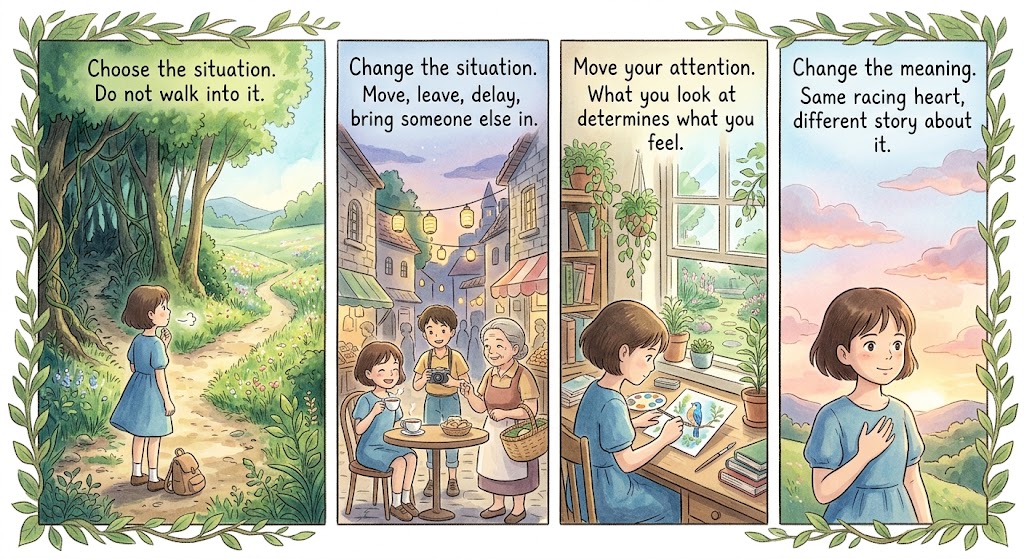
- Choose the situation. Do not walk into it.
- Change the situation. Move, leave, delay, bring someone else in.
- Move your attention. What you look at determines what you feel.
- Change the meaning. Same racing heart, different story about it.
- Control your face. Last resort. Weakest. Expensive.
Notice that arguing with yourself is not on the list.
Each of the next twelve posts takes one pair of things that seem to contradict each other, and shows why they do not. Feeling angry and choosing your response. Caring deeply and protecting your energy. Being confident and saying you do not know.
The theme running through all of them is the same. Two systems, two timescales, two toolkits. Trouble starts when you use the wrong tool on the wrong system, then conclude you are broken because it did not work.
You are not broken. You brought a spreadsheet to a knife fight.
Series notes
The through line
Every pair in this series looks like a contradiction because we assume the mind is one system that ought to agree with itself. It is not, and it does not have to. Feelings arrive from a fast system built for keeping a body alive. Judgement arrives from a slower one. They run at the same time, on different clocks, using different information.
Both can be true. That is not a paradox to resolve. That is just what the equipment does.
On the science
These posts describe real findings with real limits. Effect sizes in this field are mostly modest, several famous results have not replicated, and the honest caveats in each post are not decoration.
Sources
Linked in the posts above:
- Butler, Egloff, Wilhelm, Smith, Erickson and Gross (2003), The Social Consequences of Expressive Suppression, Emotion
- Lieberman, Eisenberger, Crockett, Tom, Pfeifer and Way (2007), Putting Feelings Into Words, Psychological Science
- Klimecki, Leiberg, Ricard and Singer (2014), Differential pattern of functional brain plasticity after compassion and empathy training, SCAN
- Klimecki, Leiberg, Lamm and Singer (2013), Functional neural plasticity after compassion training, Cerebral Cortex
- Singer and Klimecki (2014), Empathy and compassion, Current Biology
- Jamieson, Nock and Mendes (2012), Mind over matter: reappraising arousal, JEP: General (free text)
- Brooks (2014), Get Excited: Reappraising Pre-Performance Anxiety as Excitement, JEP: General
- Wood and Porter (2019), The Elusive Backfire Effect, Political Behavior (free preprint)
- Bruk, Scholl and Bless (2018), Beautiful Mess Effect, JPSP (accessible write-up)
- Yeager, Purdie-Vaughns, Garcia, Apfel, Brzustoski, Master, Hessert, Williams and Cohen (2014), Breaking the Cycle of Mistrust, JEP: General (summary)
- Kahneman and Klein (2009), Conditions for Intuitive Expertise: A Failure to Disagree, American Psychologist
- Edmondson (1999), Psychological Safety and Learning Behavior in Work Teams, Administrative Science Quarterly
- Lisa Feldman Barrett, How Emotions Are Made and Seven and a Half Lessons About the Brain, on constructed emotion and on why the triune brain model is wrong
- James Gross, the process model of emotion regulation
- Robert Zajonc (1980), Feeling and Thinking: Preferences Need No Inferences
- Eddie Harmon-Jones, on anger as an approach-motivated state
- Alicia Grandey, on surface acting and burnout
- Dan Kahan, on identity-protective cognition
- Geoffrey Cohen and David Sherman, on self-affirmation and defensiveness
- Philip Tetlock, Superforecasting, on incremental belief updating
- Herbert Simon (1992), on intuition as recognition
Provided by Kai