
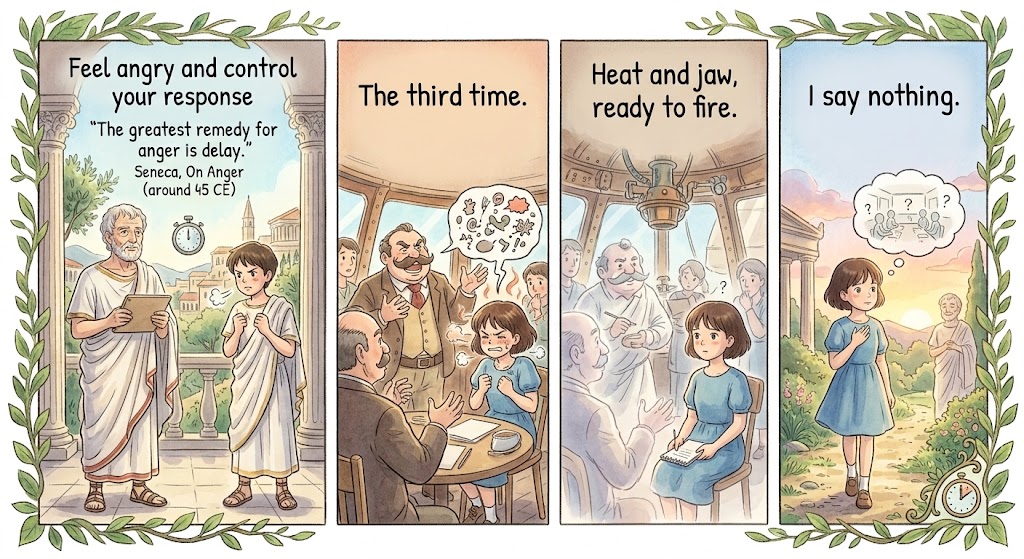
"The greatest remedy for anger is delay." Seneca, On Anger (around 45 CE)
The moment
Third time in the same meeting. You start a sentence, they take it. Heat in the chest, jaw set, and a reply already fully written in your head, waiting to be delivered. You say nothing, because saying it would be a disaster. And then for the next twenty minutes you absorb almost none of what is discussed, because you are still holding the reply.
This post is about that specific window. Not anger in general. The minute or two where you have the feeling and have not yet done anything with it.
Nearly all the advice for that window is one instruction: calm down. It does not work, and it is worth knowing why before we get to what does.
Why "calm down" is the wrong instruction.
What is actually happening
Anger is not a shutdown state. It is a go state. Work by Eddie Harmon-Jones and others found that anger shows the same pattern of brain activity as approach and pursuit, the pattern you see when someone wants something and is moving toward it. Fear makes you withdraw. Anger makes you lean in. That is why anger feels energising rather than draining, and why it is so easy to act on.
So the problem is not that anger swamps your thinking. The problem is that anger arrives as a finished action plan, drafted and ready, before your thinking was consulted at all.
You cannot cancel a plan by wishing. You can decline to execute it, and you can change the conditions it was drafted under. That is what the moves below do.
They come from James Gross's process model of emotion regulation, which is the most practically useful thing in this field. Gross's point is that a feeling has a life cycle, and there are five different points where you can intervene. The earlier you get in, the cheaper it is. The list runs earliest to latest, which is also, roughly, best to worst.
Move 1: Do not walk into it
The cheapest anger to manage is the one that never starts.
This is unglamorous and it is why people skip it. If the same weekly call leaves you furious every single time, the highest leverage move happened days ago, when you accepted the invitation.
What it sounds like in practice: declining the standing meeting and asking for the notes. Not sitting next to that person at the dinner. Doing the difficult conversation on the phone rather than over text, because text is where you reread things eleven times.
When it fails: when avoidance becomes the whole strategy. If you are choosing your way out of every situation that could produce a feeling, you are not regulating, you are shrinking. This move is for the recurring, predictable, low-value ones.
Move 2: Change the situation you are already in
You are in the room. You cannot leave the room. You can still change what the room is doing.
Move the meeting to the afternoon. Ask for the agenda in advance. Bring a third person. Say the difficult thing at the start rather than letting it sit for fifty minutes. Put the shared document on screen so the disagreement is about a document rather than about two people.
Almost every recurring flashpoint has a structural version of itself that nobody has bothered to change, because everyone is treating it as a personality problem.
When it fails: when the thing making you angry is the point of the meeting, not the setting of it.
Move 3: Move your attention
What you look at determines what you feel. This sounds like a slogan. It is closer to a mechanical fact.
If your attention is locked on the person's face while they talk over you, you are feeding the state. Look at the document. Take a note, an actual one, about the content. Count something. Look out of the window for four seconds.
This is not the same as pretending it did not happen. You are not deciding the interruption was fine. You are declining to keep pouring fuel on a fire while you decide what to do about it.
When it fails: when the thing needs your attention. You cannot look away from a live problem and call that regulation.
Move 4: Change what it means
Same racing heart, different story about it. This is the move with the strongest evidence behind it, and it is also the slowest to learn.
The version that works is not "it's fine" or "they didn't mean it." Those are usually lies, and you know it. The version that works is more specific and more honest: what else could be true here.
They interrupted you three times. Possible readings: they think your point is weak. They are anxious about time. They do this to everyone and have never once noticed. They were told before the meeting to get to a decision.
You do not have to believe the most generous reading. You just have to notice that your first reading arrived at speed, with confidence, and without evidence, which is exactly what a fast system produces. The tool that makes this move possible is naming, and there is real work behind it. Matthew Lieberman's group found that putting a feeling into words reduced activity in the amygdala and increased it in a region tied to processing in words. The effect is modest and it has been badly oversold online, so do not expect magic. But specific beats vague, reliably. "I am angry because I was interrupted and it made me feel dismissed in front of people whose opinion I care about" does more work than "I'm annoyed." The first one names a problem you could act on. The second one names weather. When it fails: in the first thirty seconds, when the state is at full strength. Reappraisal is a slow tool. Which is why the next move exists.
Move 5: Control your face
Last resort. Weakest. Most expensive. And it is what most people reach for first.
Holding the expression in while the feeling continues reduces what shows on your face and almost nothing else. The feeling stays. Your body stays loaded. And it is not the private, contained act people assume it is.
In a study by Emily Butler and colleagues, women told to hide their emotional expressions during a difficult conversation ended up disrupting the conversation itself, and their partner's blood pressure went up. In a second study, suppression raised blood pressure in both people and left the listener less interested in getting to know the person who had been suppressing. Read that again. The other person's body registers that something is off, even when they cannot say what. Suppression is not invisible. It is just unlabelled. Use it when you genuinely have no other option, for a short period, and know it is costing you something.
Running one situation through all five
Take the interruption.
Move 1: is this a meeting you need to be in, or is it a status meeting you attend out of habit? If it is the second, the whole problem is solvable by email.
Move 2: can you ask for two minutes of uninterrupted time at the top, as a standing item? Most chairs will say yes and never think about it again.
Move 3: in the moment, note down the actual point you were making. Your attention goes to the content and you keep the thing you were about to lose.
Move 4: say silently what specifically happened and why it stung. Interrupted, dismissed, in front of these people. Then ask what else might be going on, without needing to believe it.
Move 5: if none of that was available, hold the face, and know you are paying for it.
Notice what is not on the list at any point: arguing with yourself about whether you are entitled to be angry. That is not a regulation strategy. It is a second argument, running alongside the first, and it costs you attention you needed for the first one.
The one that is not on the list
Buy time physically. Anger is an approach state, so anything that interrupts approach works. Stand up. Get water. Say "let me come back to that." You are not suppressing. You are declining to execute the plan your body drafted, which is a different act with a different cost.
The honest caveat
None of this means anger is a malfunction, or that delay is always right. Anger tracks unfairness better than almost any other feeling we have, and people who never act on it tend to accumulate resentment instead, which is worse and lasts longer. Several of these findings are modest in size, and the naming research in particular has been stretched well past what the studies support.
The skill is not deleting the signal. It is separating the signal from the script that arrives attached to it.
Try this week
Pick the one recurring situation that reliably makes you angry. Do not work on your response to it. Work on move 1 or move 2 instead, and change something about the situation itself before it happens again.
Provided by Kai