
Most apps answer this with a shrug dressed up as an algorithm. You both like hiking. Here is a stranger.
We can do better than that, but we are not there yet, so here is the real answer, including the part that is a bit embarrassing.
What picks your partner today
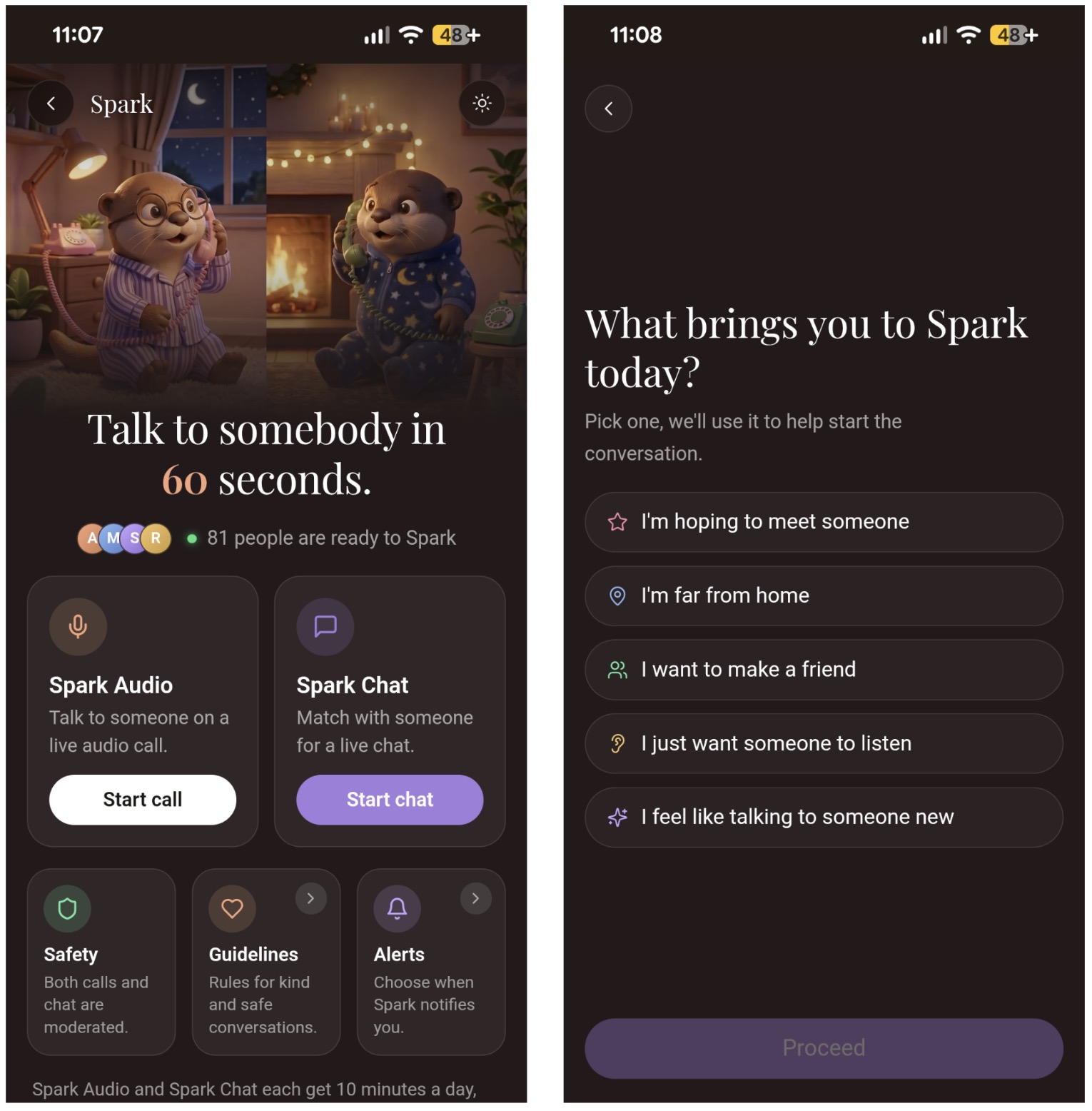
When you tap Start call, Spark looks through everyone waiting right now and tries these things in order:
- Someone who shares an interest with you.
- Someone who prefers the same language as you.
- Someone who speaks a language you speak, even if it is not their first.
- Someone from a Space you are both in (Spaces are member-generated mini communities).
- Anyone who is waiting.
- If almost nobody is online, we widen the net rather than leave you staring at a spinner.
So yes. The very first thing we reach for is your interests, which is the weakest thing we know about you.
We know it is weak. Interests are what people type to get past a form. They tell you what someone wants to be seen as, not what they are like to talk to for three minutes on a Tuesday night. Two people who both wrote "music" can have nothing to say to each other. Someone who wrote nothing can be the best call you have all week.
If you have ever put travel, food and movies on a profile, you were filling in a box, not describing yourself. We are in the middle of replacing this, and the rest of this post is about what with.
The part that already works better
On top of that list sits a second layer, and this one is not about what you like. It is about how your calls have actually gone.
Two things happen there.
Pairings that have historically gone badly get avoided. Some combinations end in the first fifteen seconds, over and over. We would rather know that before we put a call through than after.
If you and someone else keep having very short calls, we stop putting you together for a while. Not a ban. A rest. Sometimes two people just do not click, and the honest response is to stop insisting.
This is behaviour, not personality. It is built from what happened on real calls, not from anything you told us about yourself.
Right now, we’re running a useful experiment for your benefit
That second layer is switched on for about half of Spark, at random. The other half gets the plain list. Over the last week that was roughly nine and a half thousand matches on the new ordering against nine thousand on the old one.
We are watching two things. Whether calls get past the first minute, and whether a message follows afterwards. The second one matters more, and here is why.
The measurement that predicts whether someone is still here in a month is not how many calls they took. It is whether they messaged someone on more than one separate day in their first week. One message a day gives almost nothing. Two changes everything. Calls matter too, but later, for whether people are still here in month two.
So Spark's job is not to fill twenty minutes. It is to produce a conversation that continues after the call ends.
The question we ask before you join
"What brings you to Spark today" gives Kai something to open the conversation with, which is what the screen says it does.
We think it should do more than that. What you need tonight is the only thing we know about you that is actually current, and it is the one signal that should be matched the opposite way round: someone who wants to be listened to and someone happy to listen is a better call than two people who both want the floor.
Why the passport decides nothing, and is still being built
Kai remembers your conversations, and over time that memory becomes a passport. Not a transcript. A structured picture of how you talk: how much warm-up you need before you say anything real, whether you tend to lead a conversation or follow it, what you are actually in the middle of right now.
Those are the things that decide whether a call works, and almost nobody can write them down about themselves, which is why we do not ask.
To be completely clear: today the passport plays no part in choosing who you meet. It is being built across the active platform, thousands of them refreshed every week, and it is switched off at the point where it would pick a person. The matcher and the memory are two separate systems that do not touch yet.
That is deliberate. A memory built over months is worth switching on. A memory switched on the day it is invented is a guess with a confident voice.
Three rules govern it before it goes anywhere near a match:
- One way in. A single part of the system can write to your passport. Nothing else puts words in your mouth.
- Told apart from guessed. Something you said directly is stored differently from something we worked out. Guesses stay marked as guesses.
- Corrections stick. If we get something wrong, saying so does not just edit it. It marks the thing as wrong so it cannot come back later by another route.
What is not in there
No attractiveness ranking. No popularity score. Nobody is sorted by desirability and shown to people in the same bracket.
We do not optimize for time in the app either. If the best outcome of a Spark is that you two carry on somewhere else, that counts as a win on our own scoreboard.
What we need to find out
The experiment above is a 50/50 test. If the half of you on the new ordering have calls that are no longer in length, and you fail to message anyone afterwards, then the ordering is doing nothing and we adjust the method going forward.