
Kai is a place where people talk about things they do not say out loud anywhere else. Loneliness, a bad week, a friendship that fell apart, a night that felt too long. That trust is the whole product. So the way we handle it matters more than any feature we could ship.
Here is how safety actually works at Kai, in plain terms.
First, Kai is not a mental health care app
Kai is not a therapist. Not a counsellor. Not a doctor. Not a crisis line.
Kai does not diagnose anything, does not treat anything, and does not give medical or psychological advice. It will not tell you what condition you have, what medication to take, or what treatment to try. If you are looking for care, Kai is not the answer, and we would rather tell you that than pretend otherwise.
What Kai does is more modest and, we think, still worth building. It listens. It helps you notice patterns in how you feel. It helps you find people who are going through something similar. When someone needs more than that, our job is to say so clearly and point to a real human who can help.
Safety happens in layers
There is no single filter that keeps a community safe. We run several checks that do different jobs, and they run in a specific order for a reason.
Layer one runs before anything else. The moment a message arrives, we check it against a list of phrases that signal self-harm or suicide. This happens before Kai starts writing a reply and before any other review runs. If it matches, the conversation leaves the normal path immediately and goes to crisis handling.
We put this first on purpose. Everything else in the system depends on an AI model responding, and models can be slow or can fail. This check is simple, instant, and never depends on anything else working.
Layer two reviews every message. Everything sent to Kai goes through content review before Kai responds. Rather than a yes or no verdict, we sort conversations into levels of concern. Ordinary conversation gets ordinary Kai. A heavier conversation changes how Kai responds: slower, plainer, less advice, more listening. A serious one changes it again and brings in support resources. A crisis stops the normal conversation entirely.
The point of levels instead of a switch is that most hard conversations are not emergencies, and treating them like emergencies teaches people to stop being honest with you.
Layer three covers everything people send each other. Kai is not only a conversation with an AI. There are direct messages, comments, feed posts, Spaces, Circles, and live audio rooms. All of it is reviewed automatically: direct messages, comments, feed posts, posts and comments inside Spaces, chat in Spaces and Circles, and audio in live sessions. Every surface, all the time.
That review works across the languages our members actually use, not only English. We are an India-first product. A safety system that only reads English is not a safety system.
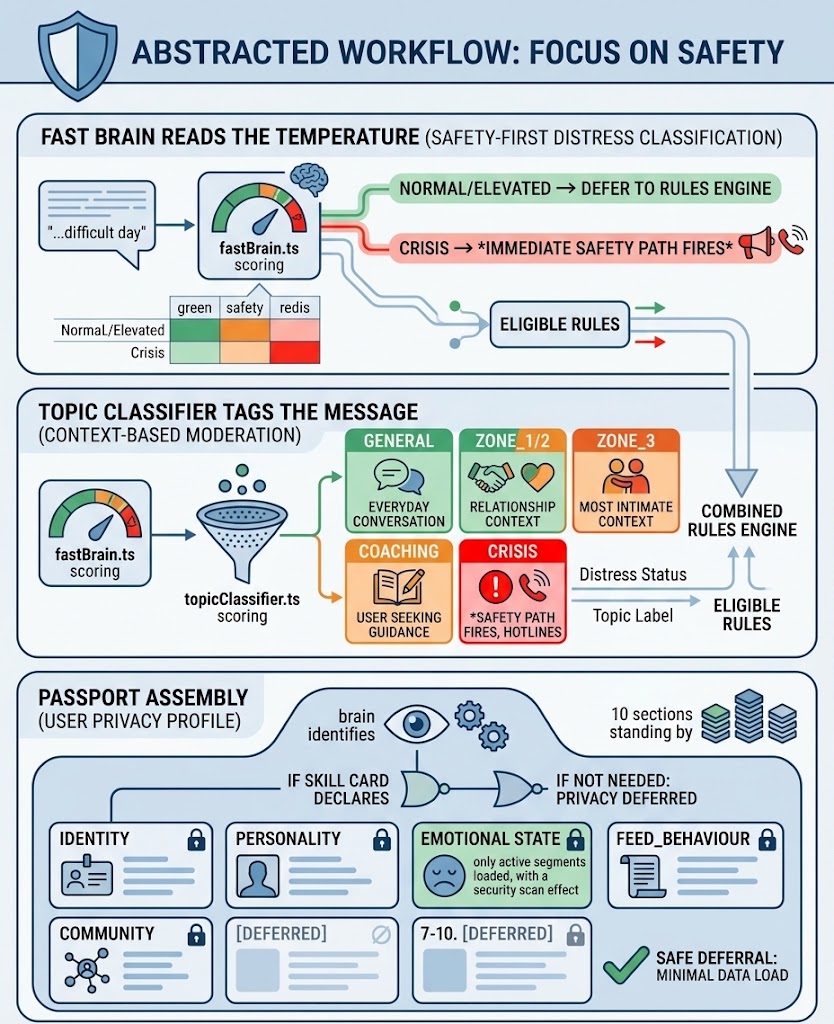
What happens in a crisis
Two independent things have to fail before a crisis message goes unnoticed. The instant phrase check has to miss it, and the model review has to miss it too. They work differently and fail differently, which is the entire point of having both.
When either one fires, Kai stops doing what it was doing. It does not continue the previous topic, does not give advice, and does not try to handle the situation itself. It responds simply, and it surfaces real help. In India that includes AASRA. We also follow up afterwards rather than treating a single message as a closed case.
To be clear about the limit: we are not an emergency service, we cannot send help to your door, and nobody at Kai is watching your conversation live. If someone is in immediate danger, emergency services and a crisis helpline are the right call, and Kai will say so.
We get things wrong on occasion
Automatic review flags things it should not. Someone quotes a song lyric. Someone tells a story about a friend from years ago. Someone uses dark humour with people who know them well. The system sometimes treats these as serious, and the conversation gets more careful than it needs to be.
We accept that trade. A system tuned to never interrupt a real person is a system that misses the one message that mattered. When we are wrong, we would rather be wrong by caring too much.
If a decision looks wrong to you, report it. Every reported case gets looked at by a person, and that is how the thresholds get better.
What safety does not mean
It does not mean a perfectly pleasant feed. People will disagree with you, and Kai is not going to remove someone for holding an opinion you dislike.
It does not mean surveillance. The checks described here are automated. They exist to catch harm, not to build a file on you.
And it does not mean clinical care. That is worth saying twice, because AI products in this space are drifting toward implying otherwise. Kai supports connection. Care comes from professionals.
What we build instead: memory, and the people it finds you
Kai remembers you. Not a transcript played back at you. The things that actually matter: what you care about, what you are working through, how you like to be spoken to, who is important in your life. We call that your Kai Passport.
Most chat products forget you the moment you close the tab and make you explain yourself again from scratch. That is fine for looking up a recipe. It is useless for loneliness, where the entire point is being known by something that does not need the backstory every time.
So the passport fills in slowly. In your first few conversations Kai knows almost nothing about you. A month in, it knows you moved cities, and that the move is why the evenings are hard, and that you have already tried the obvious advice. It stops repeating things back to you that you worked out weeks ago.
Memory has rules:
- Only one path can be written to your passport. Nothing else in the product can put things in it.
- Some things never get stored: details about other people you mentioned, things Kai said rather than things you said, and anything you have already corrected.
- What you told us directly is marked as different from what Kai guessed. A guess stays labelled as a guess.
- You can correct it, and the correction holds. Tell Kai that something is not true about you and it does not quietly come back later.
The reason we bother is connection. Early on, introductions are broad, because all we have is what you chose to tell us on day one. As the passport fills in, they get narrower and better: shaped by the conversations that went somewhere, the Spaces you stayed in, the people you kept talking to after the first call.
The aim is not a bigger feed of strangers. There are fewer introductions, more of which turn into someone you actually keep.
What we are working on next
Two things. Better handling of the difference between talking about a hard experience and being in one right now, because those read similarly to a machine and feel nothing alike to a person. And clearer in-product explanation of why a conversation changed tone, so a careful moment does not feel like a punishment.
If you find a case we handled badly, tell us. It is the fastest way this gets better.
If you or someone you know is in crisis, please contact a local emergency number or crisis helpline. In India, AASRA is available on 91-9820466726.
Give us a try at Together with Kai