
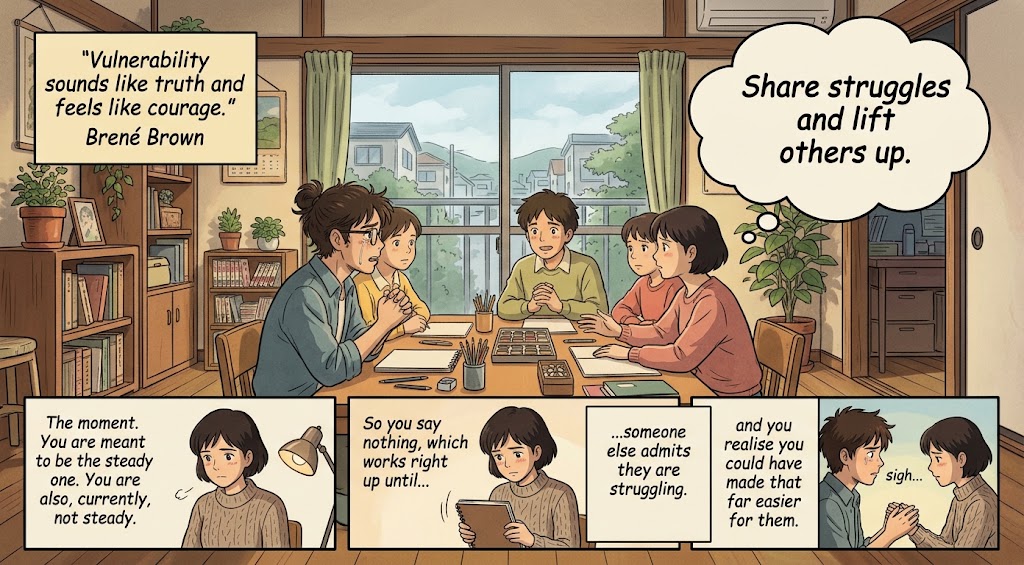
"Vulnerability sounds like truth and feels like courage." Brené Brown, Daring Greatly (2012)
This happened to me: There was a stretch of about four years where I was the person other people fell apart in front of.
Not by design. It happened the way these things happen. I was slightly older than most of the team, I did not raise my voice, and the first time someone came to me in a bad state I handled it reasonably well. Word gets around. Within a year I had a queue.
I was proud of it, in the way you are proud of something that is quietly eating you. I had a line I used on myself: someone has to be the floor. If everyone is falling, someone has to be the thing they land on.
What I did not notice was that the floor never gets to say anything.
The Tuesday it stopped working
We were about eight weeks from a deadline that mattered more than it should have. I had been sleeping badly for a month, in the specific way where you wake at four and start doing arithmetic. A supplier had gone quiet. My father was ill, four thousand miles away, and I had told exactly one person about it, and only because they had asked me a direct question I could not dodge.
On the Tuesday, one of the engineers came into the meeting room and said, without much preamble, that he was not coping. He had been hiding a slipping timeline for three weeks because he thought admitting it would end his probation. He was shaking slightly. He apologised roughly six times in four minutes.
And here is the part I still think about. My first internal reaction was not sympathy. It was envy.
He got to say it. I had been running the same script for a month with better concealment and no relief whatsoever, and he had just walked in and put it on the table, and the room had not fallen in.
I did the correct managerial things. Reassured him, restructured the timeline, told him the probation thing was not real. He left looking about ten kilos lighter. I sat there for a while afterwards feeling something I could not name for another two days.
What I eventually landed on was this: I had spent four years making it safe for other people to be honest, and had personally never once tested whether that safety applied to me.
What I did next, and it was not brave
I did not have a revelation. I did something much smaller.
About a week later, in a normal Monday stand-up, when someone asked how the supplier situation was going, I said: "Honestly, badly, and I have been carrying it on my own for a month and that was a mistake. I need two of you on it with me."
Twenty seconds. Nothing confessional. No crying. I did not mention my father or the four a.m. arithmetic, because that was not the room for it.
What happened in the next twenty minutes was the thing I did not expect. Three separate people said versions of "actually, while we're being straight about things." One of them had been sitting on a design problem for a fortnight. One flagged that our testing was theatre and everyone knew it. One said she had been about to resign and now was not sure.
None of that came out because I was vulnerable. It came out because I moved the line on what was sayable in that room, and everyone had been waiting an unreasonably long time for someone to move it.
Why my estimate was so badly wrong
I assumed admitting the supplier problem would cost me standing. It cost me nothing, and I have since learned that this misjudgement is not personal to me. It is systematic, it goes in one direction, and it has been measured. Anna Bruk, Sabine Scholl and Herbert Bless call it the beautiful mess effect. When people imagine themselves being vulnerable, confessing a feeling, asking for help, taking responsibility for a mistake, they rate it as weak and messy. When people picture someone else doing precisely the same thing, they rate it as courageous and good.
Their explanation makes immediate sense once you have been on both sides of it. You experience your own vulnerable moment up close and in detail, so the specifics dominate: your voice, the pause, the sentence that came out wrong. You see someone else's from a distance, where the details are invisible and only the shape of the act shows.
Which means your gut estimate of the social cost of admitting something is not a neutral estimate. It is biased high, every time, in everyone. Including in the person sitting across from you, running the same faulty calculation about you.
That is the bit that reframed it for me. I was not unusually private. I was normally miscalibrated, and so was everyone else in the room, and the effect of that is a group of people all independently deciding to say nothing.
The distinction I got wrong for four years
Here is where I want to be careful, because there is a version of this post that is irresponsible.
There is a real difference between processing something and sharing something.
Processing is what you do in the middle of it, and it belongs with a therapist, a partner, an old friend, a journal, someone whose role is not to be steadied by you. My father's illness was processing. It had no business in a Monday stand-up, and putting it there would not have been courage, it would have been a request for care disguised as openness.
Sharing is what you do when you have enough of a grip to carry your own weight while you talk. The supplier problem was sharing. I knew what I needed, I asked for it, and nobody had to look after me.
Both are legitimate. Only one of them lifts other people. If you are still going under, the story does not land as strength, it lands as an emergency, and your listener switches into rescue mode. That is a fine thing to need. It is just not the thing this post is about.
What actually does the lifting
It is not the struggle. It is the permission. When the competent person in the room says "I found that part hard too," they are not transmitting information. Everyone already suspected. They are moving the line on what is acceptable to say out loud, and that line moves for everyone at once. Amy Edmondson found something adjacent when she studied nursing units in the 1990s. The better-led teams reported more errors, not fewer. Reporting was safe, so reporting happened, and the number went up. The reporting was a sign of health, not of sickness. If she had used the raw error counts as a quality measure without understanding that, she would have concluded the opposite of the truth. I think about that finding a lot in the context of teams that look calm.
The honest caveat, which is about rank
This is not symmetric, and I got the asymmetry wrong at least twice.
When someone with power over you shares a struggle, it can land as a demand to be reassured. The people below you will feel it as work, and they will do it, and they will not tell you they are doing it. I have been on the receiving end of a founder's three a.m. crisis and it is not a gift.
So the higher up you sit, the more carefully you aim it. Keep it brief. Keep it specific to work where possible. Keep it past tense where you can, or at least keep it attached to a request rather than left hanging as a feeling. "This is hard and I need two of you on it" is usable. "This is hard" is a weight you just handed to someone who cannot put it down.
Try this week
Say one true, small, unflattering thing in a context where you are usually the competent one. Not the big one. A small one, attached to a request.
Then stay quiet and watch what other people say in the next twenty minutes. That is the whole mechanism, running in real time, and it is faster than you would believe.
Provided by Kai