
"Intuition is nothing more and nothing less than recognition." Herbert Simon (1992)
"Trust your gut" and "don't trust your gut" are both bad advice, because the answer is not a property of you. It is a property of the thing you are having a hunch about. Daniel Kahneman and Gary Klein spent years publicly disagreeing about intuition. Kahneman studied how it fails. Klein studied firefighters and nurses whose intuition saved lives. In 2009 they wrote a paper together specifically to locate the disagreement, and found they agreed more than either expected. Intuition is trustworthy when two conditions hold: 1. The environment is regular enough that there are genuine patterns available to learn. 2. You got fast, clear feedback often enough to have actually learned them. Both, or it does not count. So rather than asking whether you are an intuitive person, run the specific case through those two conditions. Here are ten.
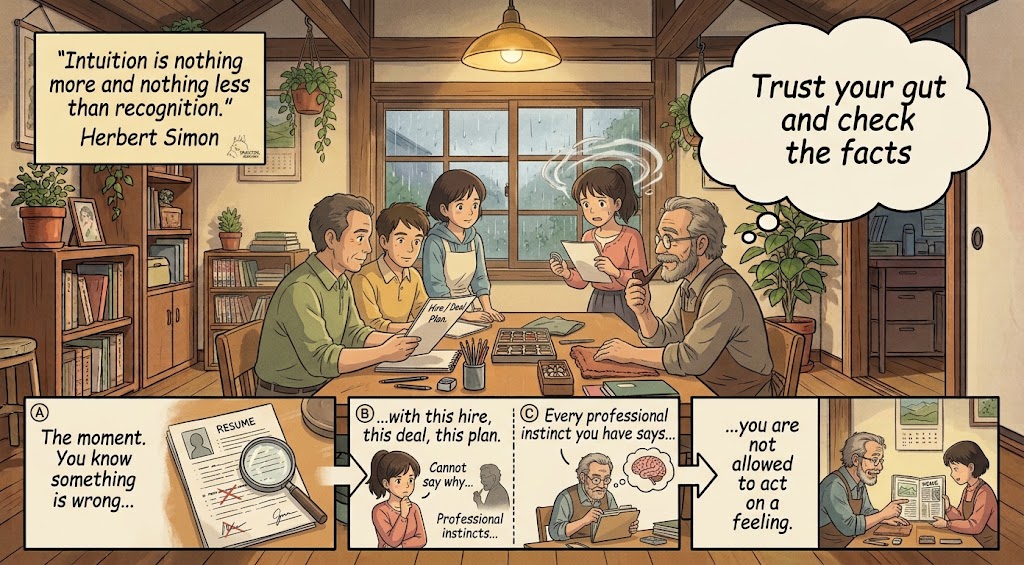
"I have a bad feeling about this candidate, but the interview went fine on paper."
Weak. Probably ignore it.
Hiring fails both conditions for almost everyone. Feedback is slow, arriving six to eighteen months later. It is heavily contaminated, because you only ever find out about the people you hired, never about the ones you rejected who would have been excellent. And the outcome depends on a hundred things that had nothing to do with the interview.
You are also in the domain where the research is least flattering. Structured interviews, where every candidate gets the same questions scored against the same rubric, consistently beat unstructured impressions. The classic numbers for how much have been revised downward in recent years, so treat the size with caution, but the direction has held up.
The move: convert the hunch into a question. If the feeling is "something is off about how they described leaving their last job," that is a reference check, not a verdict.
"I have been a nurse for eleven years and I can sometimes tell a patient is deteriorating before the observations move."
Strong. Trust it, and escalate on it.
This is the case that made Klein's career. The environment is regular, because bodies behave according to physiology. The feedback is fast and unambiguous, because you find out within hours whether you read it right. And you have had thousands of repetitions.
You are picking up a combination of skin colour, breathing pattern, alertness and something about how the person is holding themselves, which arrives faster than your reasoning can assemble the case for it. That is not mysticism. That is a very large amount of stored data, resolving quickly.
The honest limit: you will not be able to say what it was. Do not let anyone make that a reason to dismiss it, and do not let yourself invent a reason to satisfy them.
"My gut says this stock is going to drop."
Very weak. Ignore it entirely.
Markets fail the first condition badly. The environment is not just noisy, it actively rewrites its own patterns, because anything reliably learnable gets traded away. Feedback is delayed, noisy, and easy to misread, since a stock can fall for reasons that have nothing to do with your reasoning and still make you feel vindicated.
Long experience makes this worse rather than better. It produces high confidence with no accompanying accuracy, which is the most expensive combination available.
"I have been a developer for fifteen years and this code smells wrong."
Strong for structure. Weak for consequences.
Code review passes both conditions on the narrow question. Codebases are regular, and you have seen thousands of functions and learned within days or weeks which shapes cause trouble.
The strong version is "this will be difficult to change later" or "this is doing two jobs." The weak version is "this will cause an outage in production next month," because the feedback loop on that specific prediction is long, rare, and confounded.
Trust the first. Test the second.
"I have a feeling my partner is unhappy."
Strong on detection. Weak on cause.
One person over years is the definition of a regular environment with high repetition. You have a large model of one human being, and you will notice a change in it well before you can articulate what changed.
But the second half is where it goes wrong. Your gut says "something is different." Your mind immediately supplies a reason, usually the one you were already worried about, and it supplies it with total confidence and no evidence whatsoever.
Take the signal. Discard the story. Then ask.
"I have a hunch about which of two job offers to take."
Mixed, and useful in an unexpected way.
You have no pattern library for either job, so the hunch is not recognition. But it does carry real information about your own preferences, which you have plenty of data on and are frequently dishonest with yourself about.
The best use is diagnostic. Decide by coin toss, do not act on it, and notice your reaction to the result. Relief and disappointment are both readouts you cannot get any other way.
"I have a strong feeling about where this industry goes in five years."
Very weak, no matter how senior you are.
This is the one that catches experienced people, because the confidence is high and comes from genuine expertise in an adjacent thing. But nobody gets fast feedback on five year predictions. By the time you find out, you have rewritten your memory of what you predicted, and you will remember having been roughly right.
If you want to know whether your long-range intuition is any good, the only route is to write predictions down with dates and probabilities and read them back later. Almost nobody does this, which is why almost nobody knows.
"The new hire is not going to work out. I can tell in week one."
Weak, and worth actively resisting.
The failure mode here is not that you are wrong. It is that you have the power to make yourself right. Once you have decided, you assign work differently, you interpret ambiguity less generously, and you give less useful feedback. Three months later the evidence is overwhelming and you built most of it.
Give it a defined period, write down now what would change your mind, and hold to it.
"The numbers on this deal check out, but something feels off."
This is the case worth taking most seriously, and it is the reason to have this framework at all.
If you have done many deals in the same market and learned quickly which ones went bad, you have a real pattern detector, and the feeling is likely to be pointing at something the model did not capture. Often it is not the numbers, it is the counterparty: an evasion, an inconsistency between two things they said, an unusual hurry.
The move is not to override the analysis with the feeling, or the feeling with the analysis. It is to treat the feeling as an instruction to look somewhere specific. Ask yourself: if I am right, where would the problem be hiding? Then go and look there.
"Am I just an intuitive person?"
Wrong question, and the one everybody asks.
There is no general trait here. The same person can have world-class intuition about one thing and be reliably worse than a simple checklist about another, and there is no internal sensation that distinguishes the two. Well-founded intuition and pure familiarity feel identical from the inside. That is the whole difficulty.
Ask about the domain, every time: does this world give me fast, honest feedback, and have I been in it long enough to have received a lot of it?
The general rule underneath all ten
Treat the gut feeling as a flag, not a verdict.
It is telling you that something does not fit. In a domain that meets both conditions, that flag is often right and ignoring it wastes real information you paid years to acquire.
What it cannot tell you is what does not fit. And if you ask it, it will not decline. It will produce a confident answer, assembled after the fact, using whatever was nearby.
So the split is: take the flag seriously, and treat every explanation your mind offers for the flag as a hypothesis you have not tested yet.
The honest caveat
Kahneman and Klein's two conditions are a framework rather than a measured threshold. There is no test that tells you whether an environment is regular enough or your feedback fast enough, and honest people will disagree about the middle cases. Several of the domains above sit in that middle. I have given my read; yours may differ, and neither of us can settle it from the armchair.
Try this week
When you get a strong hunch about something that matters, write down two things. The hunch. And, separately, the single piece of evidence that would show it was wrong.
Then go and look for that one thing. You are not overriding the gut. You are asking it to show its work.
Provided by Kai