
Both Can Be True, part 4 of 12. Start with the series introduction.
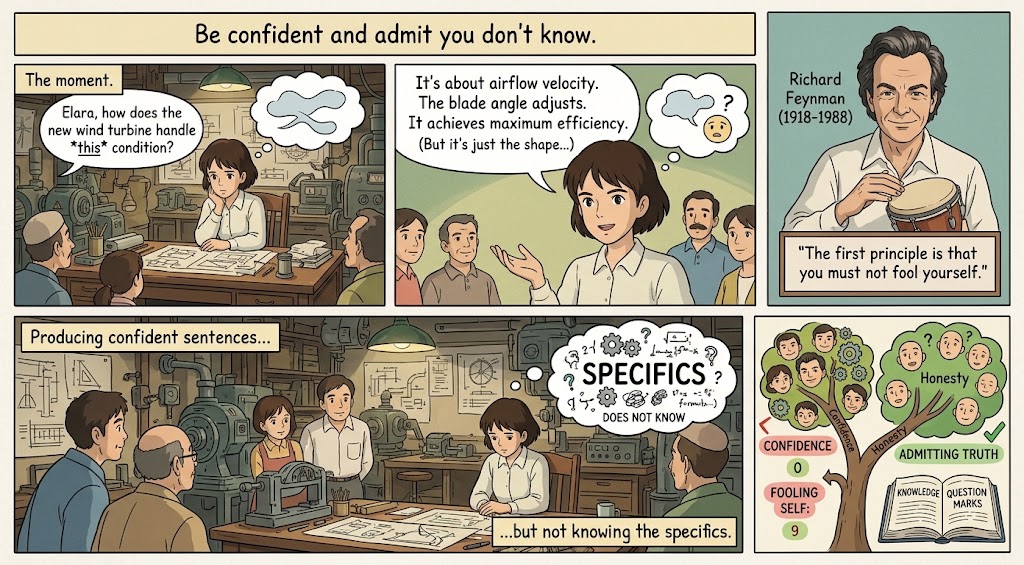
"The first principle is that you must not fool yourself." Richard Feynman, Caltech commencement address (1974)
The moment
Someone asks you a direct question in front of people who respect you. You know roughly the shape of the answer. You do not know the specifics. And you hear yourself producing three confident sentences about the shape.
What is actually happening
Confidence is a feeling, and it is not generated by checking whether you are right.
It comes largely from fluency, which means how easily something comes to mind. Information that arrives smoothly feels true. Information that arrives with effort feels doubtful. This is a fast, cheap shortcut that works surprisingly well most of the time, because familiar things genuinely are more often correct.
It also fails in a specific and dangerous way. Something you have heard many times feels smooth. Smooth feels true. You can end up highly confident purely because you have been in the room a lot.
The bit everyone quotes, with a correction
You have heard of Dunning and Kruger: people who know least overestimate most. The finding is real but it has been badly oversold. Some of the pattern shows up even in randomly generated data, because of how measurement error behaves when you compare people's self-ratings against their scores. The useful, surviving version is narrower and less funny: everyone is bad at judging their own competence, and being new to something removes the very knowledge you would need to notice you are new.
Why the two go together
Confidence in yourself and confidence in a claim are separate quantities, and most people accidentally weld them together. That is the actual problem. If your standing in the room depends on being right about this specific number, then "I don't know" costs you something and you will avoid it.
Untangle them and the cost disappears. "I'm not sure, I'll check" becomes a display of standards rather than an admission of weakness. Researchers who study intellectual humility find it tends to travel with better learning and more accurate judgement, not less influence.
How it actually sounds
The strongest version is not hedging everything. It is being precise about what you do and do not have. "I'm confident about the direction. I'm not confident about the size, and I'd want to check before we spend money on it." That is one sentence with more information in it than ten confident sentences.
The honest caveat
Context punishes this unevenly. In some rooms, hedging really does cost you, and the research on how humility is received is much thinner than the research on whether it is accurate. Know which room you are in.
Try this week
Once, when you feel the pull to fill a gap with fluency, say the true thing instead: what you know, what you don't, and when you will have the rest. Watch what happens to the conversation. It usually gets better.
Provided by Kai