
Both Can Be True, part 6 of 12. Start with the series introduction.
"Respect for ourselves guides our morals; respect for others guides our manners." Laurence Sterne, eighteenth century
The moment
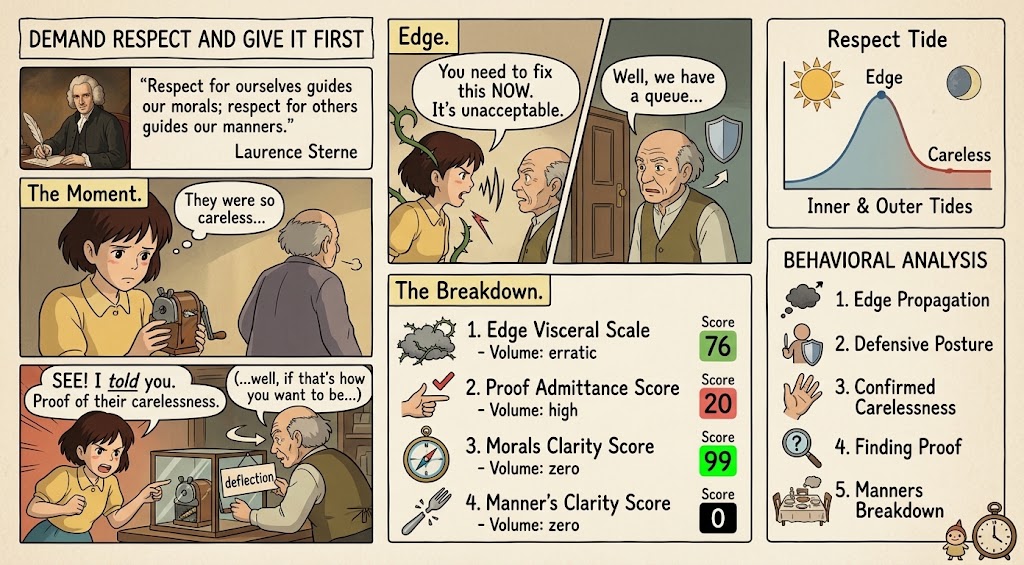
You have been treated carelessly by someone, so you go into the next conversation with an edge in your voice. They hear the edge, get defensive, and behave carelessly again. You now have proof.
What is actually happening
You built the evidence you were looking for, and it took about four seconds.
John Gottman's marriage research found that how a difficult conversation opens strongly predicts how it ends. A harsh start, meaning criticism or contempt in the first moments, tends to determine the trajectory of everything after it. Worth saying clearly: Gottman's famous "we can predict divorce with ninety percent accuracy" claims have been fairly criticised, because much of that work fitted the model to couples whose outcomes were already known. The prediction rates are shakier than advertised. The opening effect is not.
The mechanism is not mysterious. People respond to how they are treated in the moment, not to a ledger of how they have been treated historically. Your justified edge is, to them, just an unprovoked edge.
The trap this creates
Waiting for respect before extending it is a stable arrangement where nothing moves. Both people are waiting, both people feel justified, and both are technically correct about their own experience. This is the emotional equivalent of two people holding a door and each waiting for the other to go through.
Why going first is not surrender
Here is the distinction that makes the whole pair work. Respect and standards are different things.
Giving respect first means treating them as someone reasonable until shown otherwise. Warmth in tone, assuming good intent, not opening with the accusation.
Expecting respect means being clear about what you need and what happens if it does not arrive.
You can do both at once, and the combination is far stronger than either alone. "I want to sort this out with you, and I need us to stop having this conversation over text at midnight" has warmth and a boundary in the same breath. Try building that sentence out of an edge and see how far you get.
The honest caveat
Going first is a strategy, not a moral rule, and it has a limit. If you have extended respect repeatedly to someone who reliably does not return it, the finding does not say keep going. It says your opening move stopped being the deciding variable a while ago.
Try this week
Pick one recurring friction with someone. Open the next round warmer than you feel. Not fake, just warmer. Then say the hard thing plainly. The warmth is what makes the hard thing audible.
Provided by Kai