
Both Can Be True, part 11 of 12. Start with the series introduction.
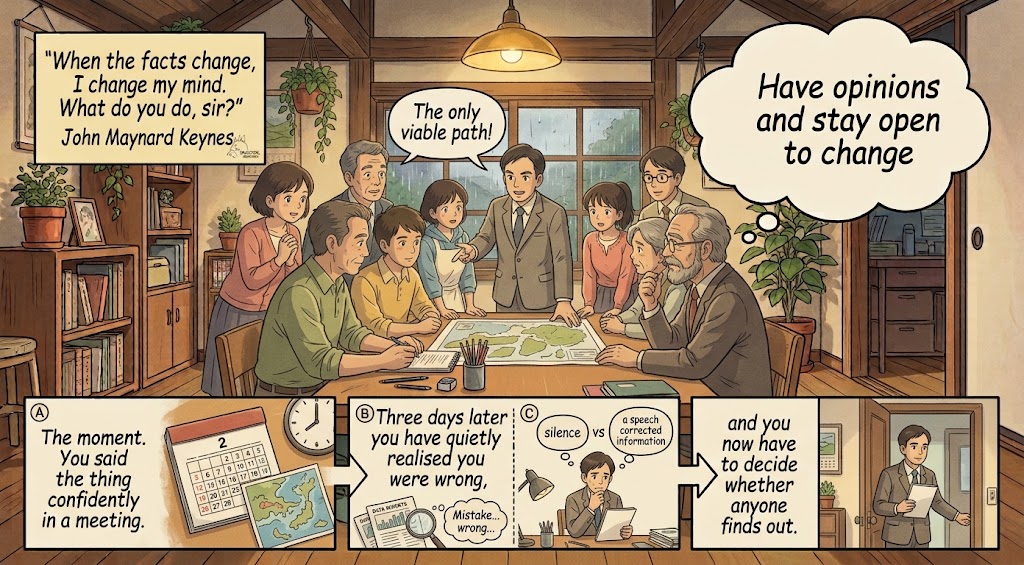
"When the facts change, I change my mind. What do you do, sir?" Attributed to John Maynard Keynes, though nobody has found him saying it
The moment
You said the thing confidently in a meeting. Three days later you have quietly realised you were wrong, and you now have to decide whether anyone finds out.
What is actually happening
The cost of changing your mind is almost entirely social, and we have built a whole culture that treats consistency as integrity. It is not. It is just consistency. Even the quote above turns out to be something Keynes probably never said, which is a fitting start for a post about how attached we get to positions.
The deeper problem is that opinions have a way of becoming furniture. You state something, other people now associate it with you, and disagreeing with it starts to feel like disagreeing with yourself. At that point you are not defending an idea any more, you are defending a possession.
What good updaters actually do
Philip Tetlock's forecasting research found that the best forecasters, the ones who consistently beat everyone else and in some cases beat intelligence analysts with access to classified material, had a distinctive habit. They updated often, and by small amounts.
That last part is the interesting bit. Not one dramatic reversal. Many small adjustments, in response to modest new evidence, each one moving them a few percent.
Poor forecasters did the opposite in both directions. They either held on rigidly until the evidence was overwhelming and then flipped completely, or they lurched around chasing whatever they read last.
Why small updates are the trick
A big reversal is expensive and embarrassing, so you avoid it, so you postpone it, so the eventual reversal gets bigger and more expensive, so you avoid it harder. Small updates never build up that pressure. Nobody has a crisis about moving from "fairly sure" to "less sure."
How to hold an opinion so it stays updateable
Put a number on it. Not for precision, for looseness. "I think this is right" is a position. "I'm about seventy percent on this" is a dial, and a dial can move without breaking.
Then say the second half out loud: what would move you. If nothing would, you do not have an opinion, you have an identity, and you should at least know which one you are carrying.
The honest caveat
Openness has a failure mode. Someone who updates on every conversation is not open minded, they are unanchored, and they are exhausting to work with. The skill is calibration: update in proportion to the strength of the evidence, which means having some sense of how strong your existing evidence was.
Try this week
Say one opinion with a number attached, and name the evidence that would move you. It feels awkward for about four seconds and then it makes you noticeably harder to argue with badly.
Provided by Kai