
Both Can Be True, part 7 of 12. Start with the series introduction.
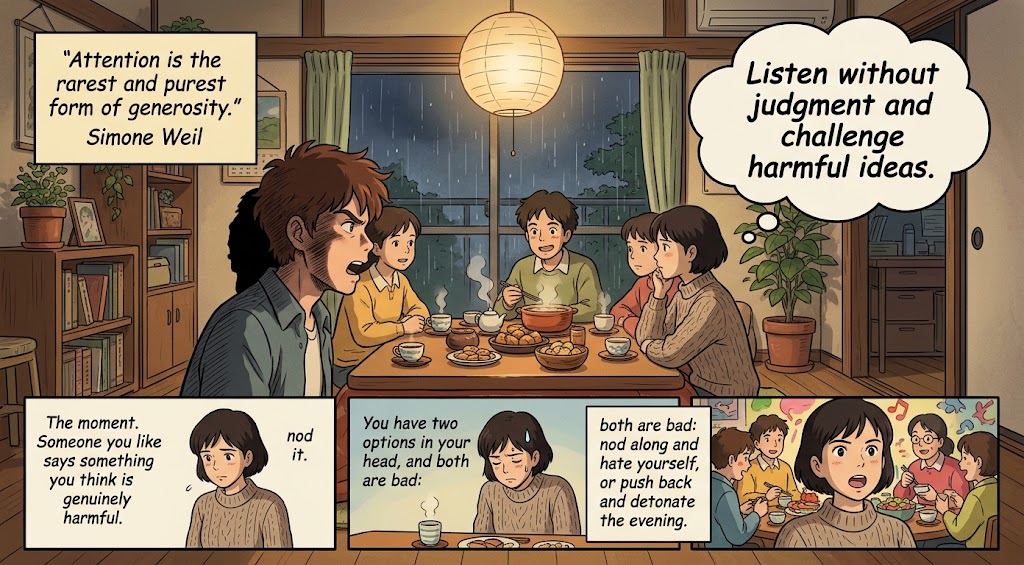
"Attention is the rarest and purest form of generosity." Simone Weil, letter to Joë Bousquet (1942)
The moment
Someone you like says something you think is genuinely harmful. You have two options in your head, and both are bad: nod along and hate yourself, or push back and detonate the evening.
What is actually happening
Most people believe there is a third option and that it does not work, because of something they half remember about facts making people dig in. Good news. That is mostly false.
The backfire effect, the idea that correcting someone strengthens their wrong belief, got enormous attention from a small early study. When Thomas Wood and Ethan Porter tried to reproduce it, across five experiments, more than 10,000 people and 52 contested issues, they found no correction capable of triggering backfire. Overwhelmingly, people moved toward accurate information. Not far, not fast, but in the right direction. (Free preprint version.)
So facts work. Just not very much, and not when something else is in the way.
What is actually in the way
Dan Kahan's research points at identity rather than information. When a belief is a membership badge for a group you belong to, giving it up is not an update, it is a defection. People are not being stupid. They are protecting something that matters more to them than being right about this particular thing, which, honestly, is often a reasonable trade.
This predicts something specific: the harder you make it feel like a loyalty test, the less the facts will land. And the reverse works too. Geoffrey Cohen and David Sherman have shown across many studies that when people first affirm something they value about themselves, they become measurably less defensive about threatening information afterwards.
So the sequence matters more than the content
Listening without judgment is not the soft preliminary before the real work. It is the thing that lowers the identity stakes enough for the challenge to be heard at all. Skip it and you are not challenging an idea, you are attacking a person, and they will correctly defend themselves.
What it sounds like
Genuinely understand it first, to their satisfaction, not yours. Then disagree without repackaging it as an accusation. "I follow how you got there. I land somewhere different and here's why" is a different event from "how can you think that."
The honest caveat
This does not always work and the effects are small. Some ideas do real harm and the right move is to say so loudly and stop caring whether the person updates. This post is about the people you have an ongoing relationship with. It is not a rule about strangers doing damage.
Try this week
In the next disagreement that matters, do not say your point until you can state theirs in a form they would agree with. Then say yours. Same words as you would have used, very different reception.
Provided by Kai