
Both Can Be True, part 3 of 12. Start with the series introduction.
"The limits of my language mean the limits of my world." Ludwig Wittgenstein, Tractatus Logico-Philosophicus (1922)
The moment
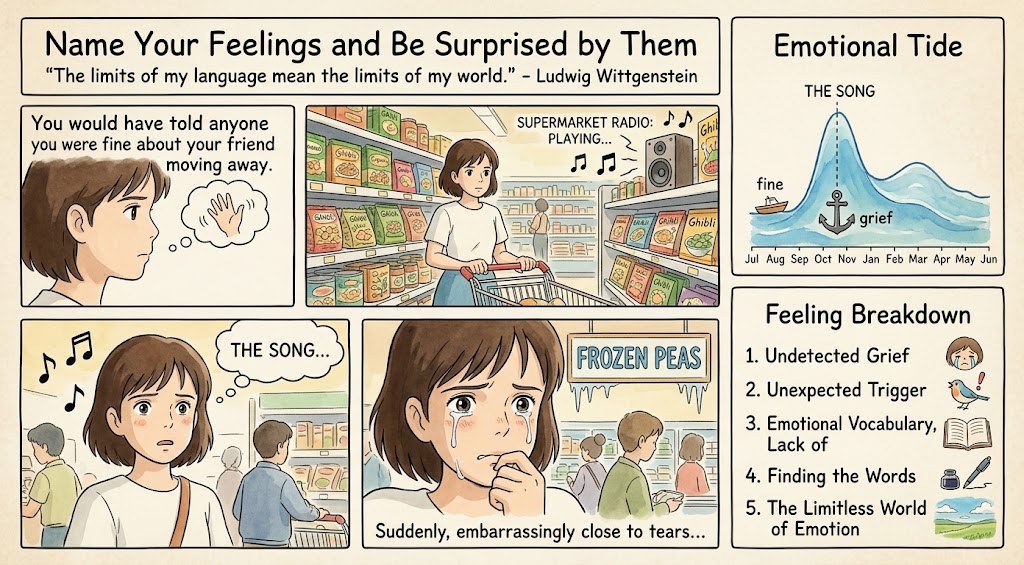
You would have told anyone that you were fine about your friend moving away. Then a song comes on in a supermarket and you are suddenly, embarrassingly close to tears next to the frozen peas.
What is actually happening
You have no direct readout of your own body. This surprises people, so it is worth sitting with.
Your heart, your gut, your lungs and your immune system are all sending signals up to your brain constantly. Those signals are noisy, delayed, and ambiguous. Your brain does not receive a clean report. It makes a guess, based on what it has predicted, what happened last time in a similar situation, and what is around you right now.
Lisa Feldman Barrett's central point is that a feeling is that guess. Not a discovery. A construction, assembled fast, using past experience as the raw material.
Which means being wrong about your own feelings is not a personal failing. It is a normal outcome of a system that works by prediction.
Why some people are better at this
There is a measurable skill here, usually called emotional granularity, and it is simply how finely you distinguish between feelings. Low granularity: good, bad, stressed. High granularity: restless, disappointed, resentful, wistful, keyed up.
People with finer distinctions tend to cope in less destructive ways. Across several studies, they drink less in response to stress, retaliate less when provoked, and use a wider range of strategies when things go wrong. The likely reason is unglamorous. A specific problem suggests a specific action. "Bad" suggests nothing except making it stop.
And here is the part the infographic gets right
Getting better at naming does not make you immune to surprise. It may even increase the number of surprises, because you notice more. The supermarket moment is not evidence you were lying to yourself. It is evidence that a prediction got updated in the presence of a cue your brain associated with your friend, and the update arrived faster than any explanation for it.
A more useful stance
Treat a surprising feeling as new information rather than as a verdict on your self-awareness. The question is not "why didn't I know this?" It is "what did that just tell me that I did not have before?"
The honest caveat
The research on granularity is mostly correlational. We know finer distinctions travel with better coping. We do not have strong evidence that deliberately expanding your feelings vocabulary causes the improvement, though small studies point that way. Treat it as promising rather than proven.
Try this week
When you notice a feeling, push past your first word to a second and third. Not "stressed" but "stretched thin and slightly resentful about it." Then notice how differently those two versions want to be handled.
Provided by Kai