
Both Can Be True, part 2 of 12. Start with the series introduction.
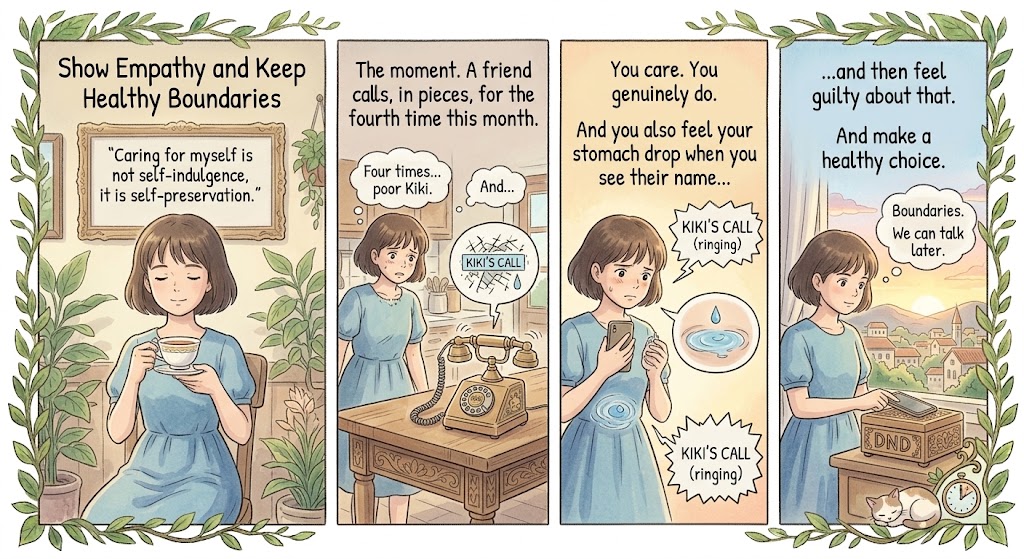
"Caring for myself is not self-indulgence, it is self-preservation." Audre Lorde, A Burst of Light (1988)
The moment
A friend calls, in pieces, for the fourth time this month. You care. You genuinely do. And you also feel your stomach drop when you see their name on the screen, and then feel guilty about that.
What is actually happening
Those are two different things wearing the same coat, and the research separates them cleanly.
Tania Singer, Olga Klimecki and colleagues ran studies where they trained people two different ways. One group practised feeling what another person feels. The other group practised caring about the person and wishing them well. Same suffering, two different responses.
• Empathy training made people feel worse. More negative feeling, and more activity in brain regions tied to experiencing pain yourself.
• Compassion training did the reverse. More positive feeling, and a different network entirely, involving regions linked to reward and affiliation. The researchers describe compassion as a way of coping with the distress that empathy alone produces. Their overview in Current Biology walks through both.
Same compassionate intent. Opposite outcomes.
What this means in ordinary words
Feeling with someone is expensive and self-limiting. If your friend's pain becomes your pain, then the only way to stop your pain is to get away from your friend. That is the mechanism behind burnout in nurses, therapists, teachers, and anyone who has ever been the designated listener in a friend group. It is not that they cared too much. It is that they were running the costly version.
Caring for someone is different. It keeps you in the room. It also keeps you separate enough to be useful, because a person drowning next to another drowning person is not a rescue.
Why boundaries are not the opposite of empathy
They are the delivery mechanism. The boundary is what makes it possible to still be there next month. The compassion research points the same way: it increased willingness to help, which is the opposite of what most people fear when they hear "boundaries."
What a boundary sounds like when it is not cold
Not "I can't do this." Try: "I have an hour tonight and I want to spend it on this properly. I can't do the whole evening." Specific, warm, finite. You are not rationing your care. You are rationing your availability, which is a real and limited thing.
The honest caveat
This has been oversold on social media, where "boundaries" now sometimes means "I have decided your needs are your problem." A boundary that never costs you anything is probably just avoidance with better branding. The test is whether you are still showing up in the form you promised.
Try this week
When someone brings you something heavy, notice which one you are doing. Are you absorbing their state, or are you steady and turned toward them? If you are absorbing, name it silently: this is their pain, and I am here. That one sentence flips the mode more often than you would expect.
Provided by Kai