
Both Can Be True, part 5 of 12. Start with the series introduction.
"Men are disturbed not by things, but by their opinions about them." Epictetus, Enchiridion (around 125 CE)
The moment
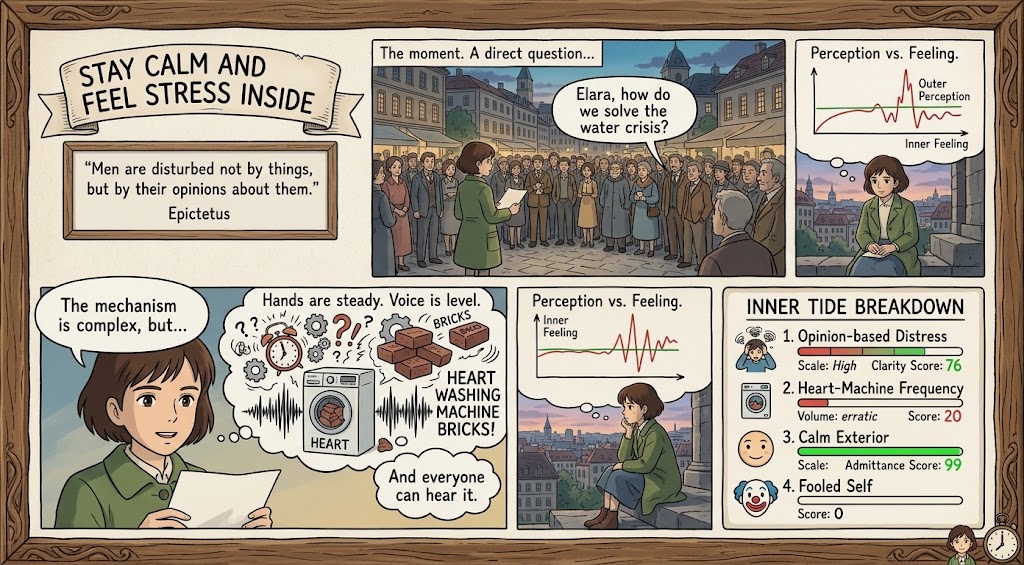
Your hands are steady. Your voice is level. Your heart is going like a washing machine full of bricks and you are convinced everyone can hear it.
What is actually happening
The visible part and the felt part run on different systems, and there is no rule that they have to match.
The more interesting finding is what happens next, and it depends almost entirely on what you decide the pounding means.
Jeremy Jamieson's group has run this experiment several times. Take people into a stressful situation. Tell one group, briefly, that a racing heart and quick breathing are the body getting more oxygen and fuel to the brain, and that this response evolved to help performance. Say nothing to the other group.
• The reappraisal group does not calm down. Their hearts still race. But their hearts pump more efficiently and their blood vessels constrict less, the pattern you see when someone is meeting a challenge rather than facing a threat. They also paid less attention to negative information. (Free full text here.) An earlier study in the same programme found the same reappraisal improved actual scores on the GRE.
• Alison Wood Brooks found something similar with an even simpler move. Before karaoke singing, public speaking, or maths under pressure, saying "I am excited" out loud beat saying "I am calm," on both performance and how people felt. Anxiety and excitement are close neighbours in the body. Excitement is a much shorter walk than calm.
Why "just relax" is bad advice
It sets the target at the wrong place. You cannot manually shut down a system that is already running, so trying and failing gives you the original stress plus a new belief that you are failing at stress. Two problems where there was one. Brooks found most people believe calming down is the right strategy, which is a nice example of a widely held instinct being the worse option.
Where the real cost sits
The damage is not in feeling stressed while looking composed. It is in the long-term version, where you spend your working life displaying feelings you do not have. Research on emotional labour, particularly by Alicia Grandey and colleagues, finds that surface acting, meaning faking the display, predicts burnout and exhaustion. Deep acting, meaning actually shifting how you see the situation, does not, or at least far less.
Same face. Completely different cost, depending on whether anything underneath changed.
Try this week
Next time your body ramps up before something that matters, do not aim for calm. Name it as fuel: my body is getting me ready. Then go. Keep the arousal, change the label.
Provided by Kai