
Introduction
Social media addiction is a compulsive pattern of checking, scrolling, and posting on social platforms despite negative effects on your mental health, sleep, and relationships. Research shows that 210 million people worldwide suffer from social media addiction, driven by dopamine-triggering design patterns like infinite scroll and variable reward notifications. The good news: it's reversible. This 30-day science-backed plan walks you through a gradual, sustainable approach to reclaiming your time and attention — without going cold turkey.
Understanding Social Media Addiction (The Science)
How Social Media Hijacks Your Brain
To break an addiction, you need to understand exactly how it works. Social media addiction isn't a metaphor; it's neurochemistry.
The Dopamine Loop
Your brain uses dopamine for motivation and reward. When something good happens, dopamine levels spike, reinforcing the behavior. This system evolved to help you survive: if eating certain foods increased dopamine, you'd seek them out. If social interaction increased dopamine, you'd seek community.
This is healthy. But here's where social media gets dangerous:
Step 1: Unpredictable rewards. Social media doesn't reward you consistently. Sometimes you post and get 50 likes. Sometimes you get 2. Sometimes you get none. This unpredictability is what creates the strongest addiction.
Research shows that variable reward schedules (where rewards are unpredictable) create more compulsive behavior than consistent rewards. This is why slot machines are addictive. This is why you can't stop checking Instagram.
Step 2: Dopamine dysregulation. When you repeatedly get these unpredictable dopamine hits, your brain adapts. It requires more dopamine to achieve the same feeling. This is called tolerance.
Meanwhile, activities that used to feel rewarding (conversation, reading, hobbies) now feel boring because they produce normal dopamine levels, not the dopamine spike from 500 strangers liking your photo.
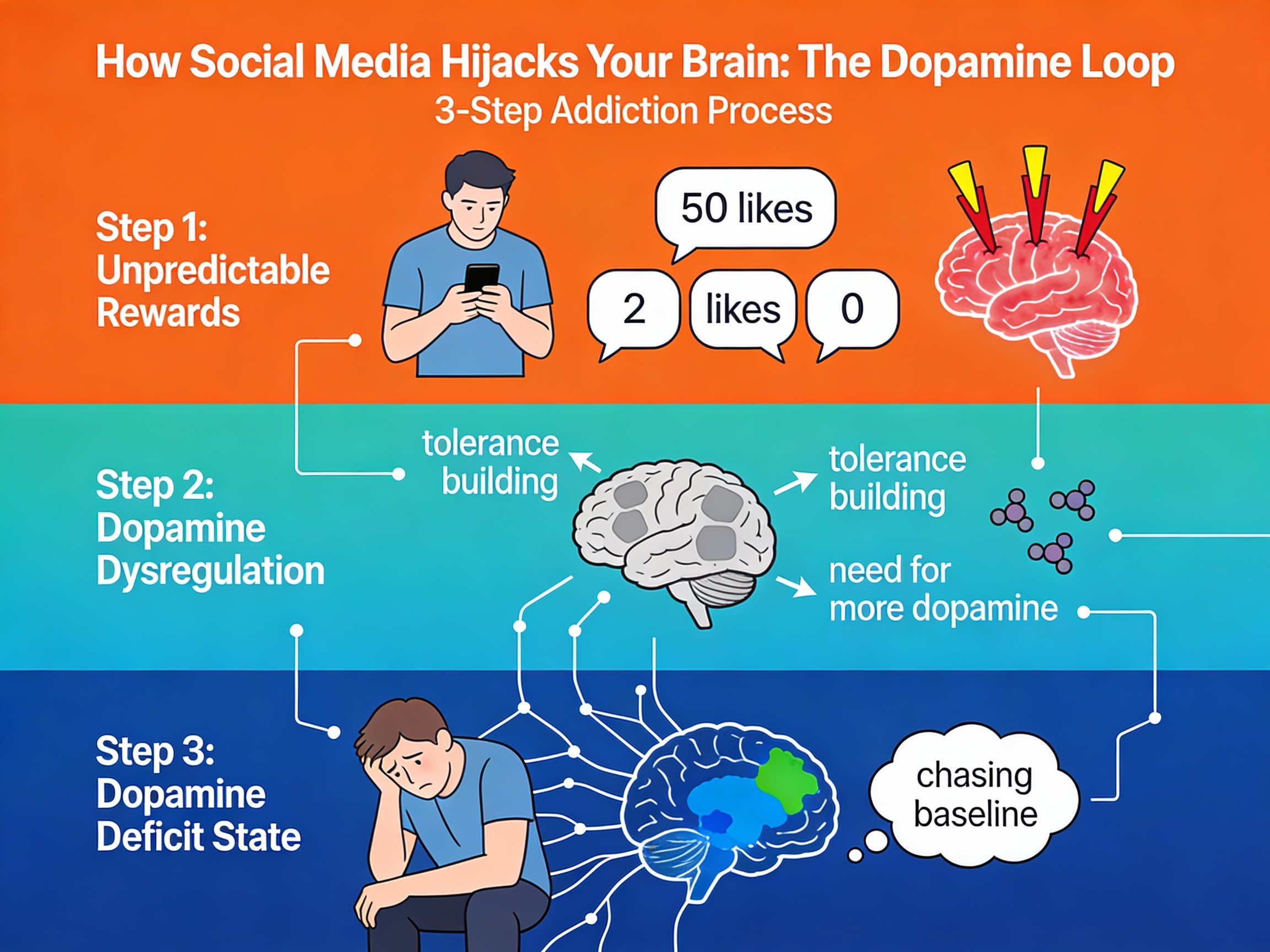
Step 3: Dopamine deficit state. Most dangerously, your brain doesn't just tolerate higher dopamine levels; it also downregulates dopamine receptors. After hours of scrolling, your baseline dopamine drops below normal. This creates the depressed, anxious, empty feeling you get after a social media binge.
Now you need the phone just to feel normal. You're chasing a baseline, not a high. This is addiction.
The Attention Capture System
Beyond dopamine, social media platforms use multiple mechanisms to capture and hold your attention:
Variable intervals: Notifications arrive at unpredictable times, creating anticipation loops
Social proof: Likes, comments, and shares trigger FOMO and status anxiety
Infinite scroll: The removal of natural stopping points (like end-of-magazine) means you never feel done
Algorithmic curation: The algorithm shows you exactly what will keep you engaged — which is often what triggers you most (outrage, comparison, envy)
Autoplay: Videos automatically play next, eliminating decision fatigue (the friction that would normally stop you)
Read receipts & notifications: You feel obligated to respond, creating compulsive checking
Each of these is a feature, and it is intentionally designed with millions of dollars of research and engineering.
The Health Consequences
Understanding the scale of the problem is important for motivation:
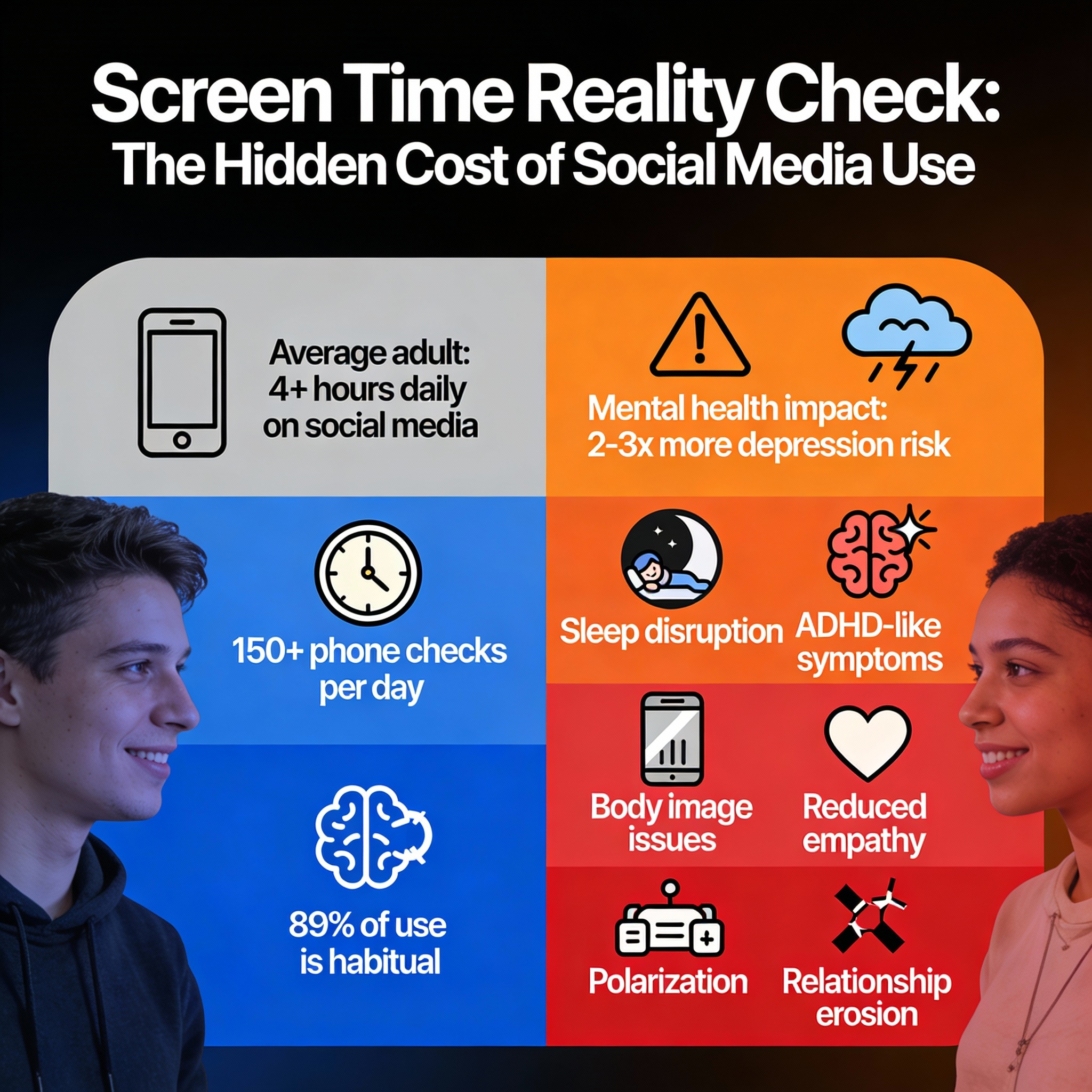
Mental health impact:
- Depression and anxiety: People who spend 2+ hours on social media daily are 2-3x more likely to develop depression
- Sleep disruption: Blue light and dopamine surges before bed disrupt circadian rhythm and sleep quality
- ADHD-like symptoms: Constant notifications and switching create attention fragmentation that mimics ADHD
- Body image issues: Social comparison on platforms creates eating disorders and body dysmorphia, especially in young people
- FOMO and existential anxiety: Constant awareness of what others are doing creates a persistent inadequacy feeling
Cognitive impact:
- Reduced focus: Your attention span shrinks with constant interruptions
- Memory problems: Information overload reduces encoding to long-term memory
- Decision fatigue: Endless choices deplete executive function
- Creativity decline: Passive consumption replaces active creation
Social impact:
- Reduced empathy: Less face-to-face interaction means lower emotional attunement
- Polarization: Algorithms separate us into echo chambers
- Comparison culture: Constant comparison with curated lives creates a persistent feeling of inadequacy
- Relationship erosion: Time on social media directly displaces time with real people
Why You're Addicted (The Psychological Factors)
Social media addiction isn't random. Certain psychological vulnerabilities make you more susceptible. Understanding your specific vulnerability helps you address the root cause.
The Vulnerability Factors
Anxiety and avoidance. Social media is a perfect escape from anxious thoughts. When you feel worried or overwhelmed, scrolling numbs the feeling temporarily. But avoidance intensifies anxiety long-term, creating a cycle: anxiety → phone escape → temporary relief → anxiety returns → repeat.
Low self-esteem and status anxiety. Social media offers a never-ending stream of external validation (likes, comments, follower counts). If your self-worth is fragile or conditional, you'll compulsively check for evidence that you matter. The algorithm knows this and optimizes for your insecurity.
FOMO (Fear of Missing Out) Humans are tribal creatures. Missing out on what your social group is doing triggers real anxiety. Notifications are engineered to exploit this: "5 people liked your post," "You have messages," "See what you missed." These aren't informational but psychological pressure tactics.
Boredom tolerance. Modern life has trained us to eliminate boredom immediately. Any moment of emptiness gets filled with a phone. This low boredom tolerance makes sustained focus on anything difficult.
Loneliness and connection hunger. Social media feels like a connection without vulnerability. You can feel socially engaged without risking genuine intimacy. For lonely people, this is especially powerful, and especially hollow.
Habit automation. After checking social media enough times, it becomes automatic. You pull out your phone without a conscious decision. Your brain has built a neural pathway: bored → reach for phone → dopamine → reinforcement.
Understanding which factors drive your addiction is crucial. If you're using social media to escape anxiety, willpower alone won't work; you will need anxiety management tools. If you're driven by FOMO, you need community and belonging. If it's boredom, you need engaging offline activities.
The 30-Day Social Media Addiction Challenge
This isn't about complete abstinence. It's about rewiring your relationship with social media from compulsive to intentional.
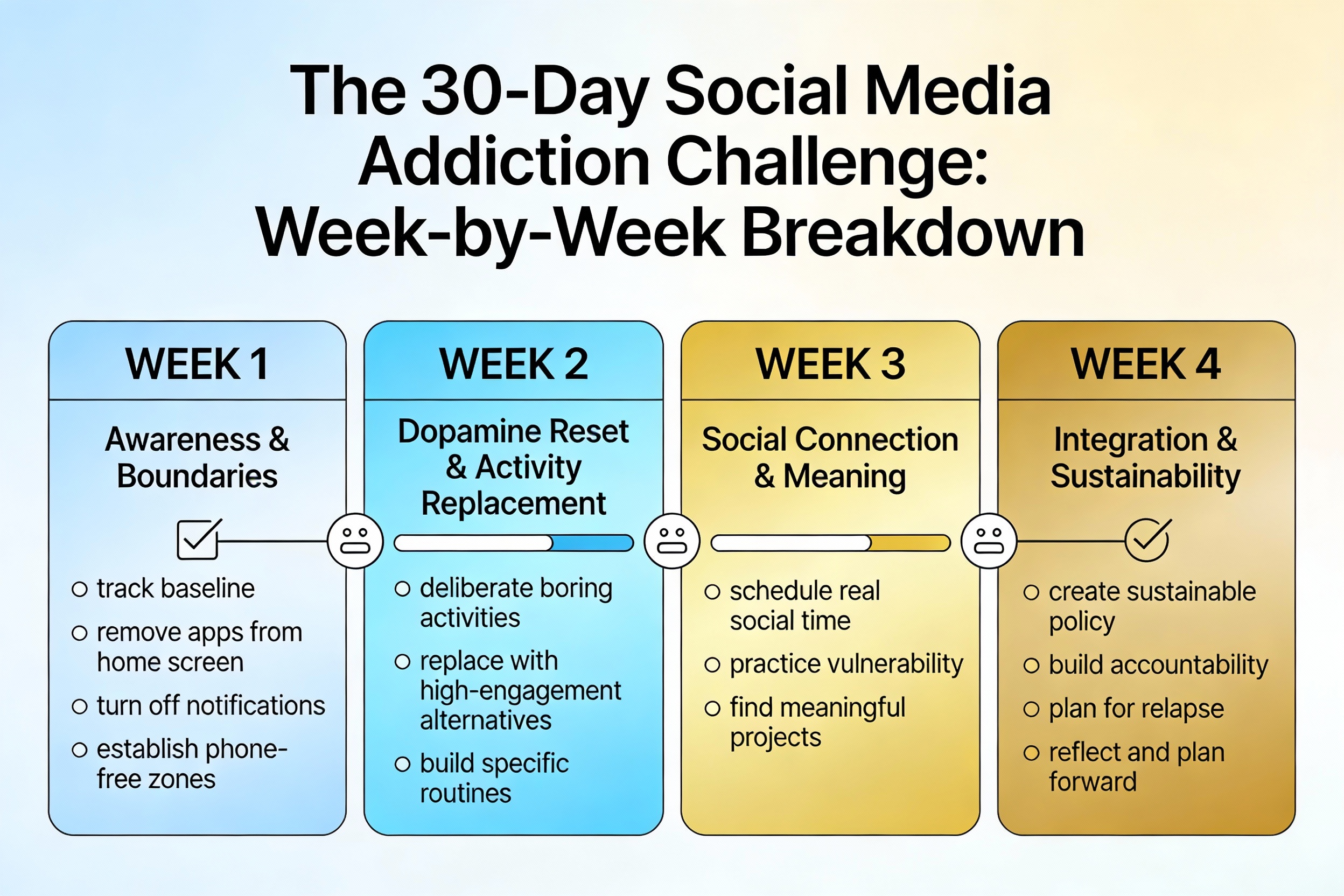
Week 1: Awareness & Boundaries
Goal: Understand your current addiction patterns and set boundaries.
Day 1-2: Track your baseline
- Install an app that tracks screen time (Screen Time on iPhone, Digital Wellbeing on Android, or Freedom/Moment)
- Don't try to change anything yet, just observe
- Note: What times are you using most? What apps? How many times do you check?
- What emotions precede reaching for your phone?
Day 3: Audit your phone setup
- Remove social media from your home screen (this removes the visual trigger)
- Move apps into folders if you can't bring yourself to delete them
- Turn off ALL notifications except calls and texts from people you know
- Delete the apps you use most (you can still access via browser if needed, but friction matters)
Day 4-5: Set specific time boundaries
- Choose 1-2 specific times per day when you'll check social media (e.g., 12 pm and 6 pm)
- Set a timer: you get 15 minutes total
- Delete the apps from your phone
- Use apps like Freedom or Space to lock yourself out during designated times
Day 6-7: Establish social media-free zones
- The bedroom is a complete phone-free zone (improves sleep, breaks bedtime scrolling)[88]
- Dining table (promotes present eating and conversation)
- First 30 minutes after waking (avoid starting the day in reactivity mode)
- Last 30 minutes before bed (protects sleep)
Expected outcome after Week 1:
- Awareness of your addiction triggers
- Boundaries set
- Anxiety when you can't access apps (this is normal and will pass)
- Potential boredom (this is good, this is where real thinking happens)
Week 2: Dopamine Reset & Activity Replacement
Goal: Start rewiring your dopamine system and replace social media time with meaningful activities.
The dopamine reset principle: Your dopamine system is dysregulated from constant stimulation. Week 2 involves deliberately boring, unstimulating activities to reset your baseline. This sucks, but it works.
Day 8-9: Deliberately boring activities
- Take walks without your phone
- Sit outside and just observe (no phone, no distractions)
- Do nothing for 20 minutes (meditate, breathe, sit)
- The goal is to feel boredom. Real, genuine boredom. This is where your dopamine system resets.
Day 10-11: Replace with high-engagement offline activities. Once you've felt boredom, engage with activities that are genuinely engaging (not just stimulating):
- Read (physical books, not screens)
- Create something (write, draw, build, cook)
- Exercise intensely
- Engage in a hobby with your full attention
- Have deep conversations
These produce dopamine but also produce meaning that is unlike social media dopamine, which is hollow.
Day 12-14: Build specific routines
- Identify the times when you most want to check social media (probably when bored or anxious)
- Create a specific alternative activity for those times
- Make it immediate-access easy (don't require setup)
Examples:
- When you want to scroll while waiting: read a physical book, do breathing exercises, write, sketch
- When you want to scroll while bored: exercise, call a friend, hobby, or go outside
- When you want to scroll before bed: read, journal, meditation, conversation
Expected outcome after Week 2:
- Reduced anxiety about not checking
- Dopamine baseline beginning to reset
- Activities that felt boring are starting to feel engaging again
- Real boredom creates space for real thinking
- Deeper sleep (no blue light before bed)
Week 3: Social Connection & Meaning-Building
Goal: Fill the void social media was occupying with a real human connection.
The core insight: Social media addiction often fills genuine connection hunger. Week 3 involves intentionally building a real connection.
Day 15-17: Schedule real social time
- Message 3 people you care about and propose a specific hangout
- Make one phone call to someone (not text, but a voice connection, which is exponentially more connecting than text)
- Join one activity/class/group you've been considering
- Have one in-depth conversation with someone
Real interaction creates satisfaction that social media can't replicate. Your brain will start to prefer it.
Day 18-19: Practice vulnerability
- Share something real with someone (a struggle, fear, goal, dream)
- Ask someone a genuine question about their life
- Listen fully without planning what you'll say next
- Notice how this feels different from "connecting" on social media
This builds the kind of connection your nervous system actually needs.
Day 20-21: Find meaning outside social media
- Identify a cause or community that matters to you
- Take one action toward it (volunteer, donate, join, attend)
- Notice how contributing to something meaningful affects your mood vs. social media scrolling
Meaning is a powerful antidote to compulsion.
Expected outcome after Week 3:
- Real social connection meets dopamine needs
- Vulnerability creates genuine bonds
- Meaning providing sustainable motivation beyond addiction
- Social media feels less necessary
- Anxiety about missing social media significantly decreased
Week 4: Integration & Long-Term Sustainability
Goal: Build sustainable practices that work long-term.
Day 22-24: Create your sustainable social media policy. You're not going to quit social media forever. But you're changing your relationship with it. Define:
- When you use it: Specific times only (e.g., Sundays 2 pm + Thursdays 6 pm)
- How long: Time limit (e.g., 20 minutes total)
- Why you use it: Specific purpose only (checking messages from close friends, seeing updates from specific people/communities)
- What you don't do: No infinite scroll, no algorithm exploration, no comparison browsing
- What triggers removal: If you find yourself using outside designated times, delete apps again
Day 25-26: Build accountability
- Tell someone your goals (social accountability increases follow-through)
- Use apps that physically prevent access (Freedom, Space, One Sec)
- Join a community of people reducing social media use (Reddit r/nosurf, digital detox communities)
- Schedule regular check-ins with yourself (weekly reflection on how it's going)
Day 27-28: Plan for relapse. You will probably slip. That's normal. Plan for it:
- Identify your specific relapse trigger (stress, boredom, anxiety, social occasion)
- Create a specific response plan ("If I feel stressed, I'll call my friend, not scroll")
- Forgive yourself when you slip (shame is the fastest path back to compulsion)
- Get right back to your plan the next day
Day 29-30: Reflect and plan forward
- How has your sleep changed?
- How is your focus and attention span?
- How are your relationships?
- How is your anxiety level?
- What's been hardest?
- What strategies worked best?
- What will you commit to long-term?
Specific Strategies for Different Addiction Types
Social media addiction manifests differently based on what drives it. Customize your approach:
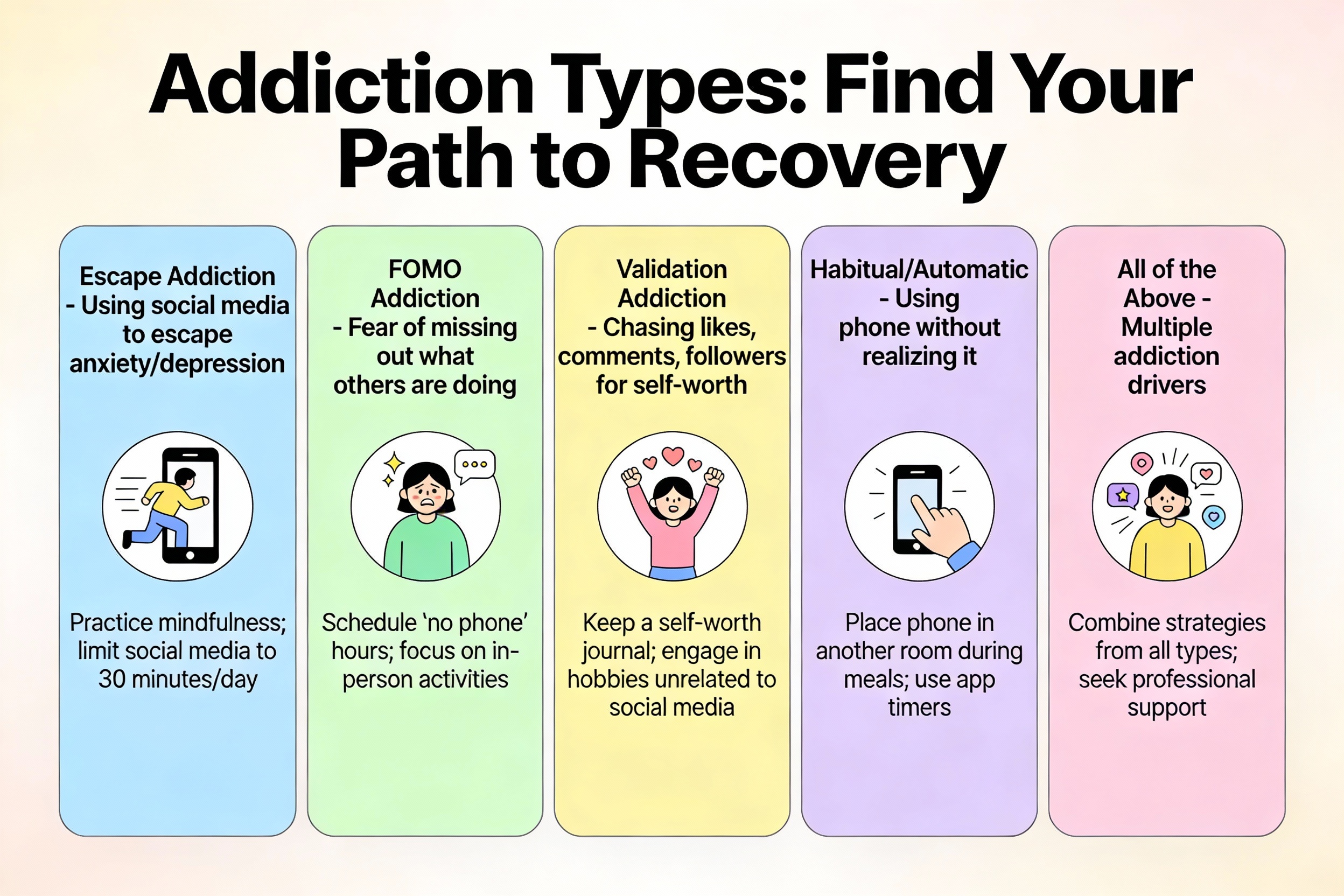
If You're Escaping Anxiety or Depression: The phone is for pain management, not entertainment.
Your strategy:
- Add evidence-based anxiety management (therapy, meditation, exercise)
- When you reach for the phone, pause and identify the feeling
- Use a specific alternate coping tool: cold shower, intense exercise, breathing exercises
- Address the root anxiety, not just the symptom
Therapies that work: CBT, EMDR, ACT (all available online/in-person)
If You're Driven by FOMO (Fear of Missing Out): You fear what you're missing more than you want what you're doing.
Your strategy:
- Limit your circles to close friends (rather than 500 acquaintances)
- Remind yourself regularly: what you see on social media is 1% of people's lives, edited and curated
- Build an offline community, so you're actually "in the loop" in your real life
- Practice the fact that you will miss some things, and that's okay
If You're Chasing Validation (Likes, Comments, Followers): Your self-worth is dependent on external validation.
Your strategy:
- Work on self-esteem through therapy or coaching
- Practice self-validation: identify 3 things you did well each day, regardless of external feedback
- Delete social media if possible (your nervous system can't heal while constantly exposed to validation cues)
- Build evidence of internal worth separate from likes
If It's Habitual/Automatic: You don't even realize you're doing it.
Your strategy:
- Environmental design (delete apps, create friction)
- Replace with automatic alternatives (when you reach for the phone automatically, have a different automatic response ready)
- Make the new behavior easier than the old one
- Track your wins (first week without the automatic reach is significant)
What to Do With Your Reclaimed Time
Here's what happens after you reduce social media: suddenly, you have 2-3 hours per day back.
This is a gift if you use it intentionally. This is terrible if you immediately fill it with something else numbing.
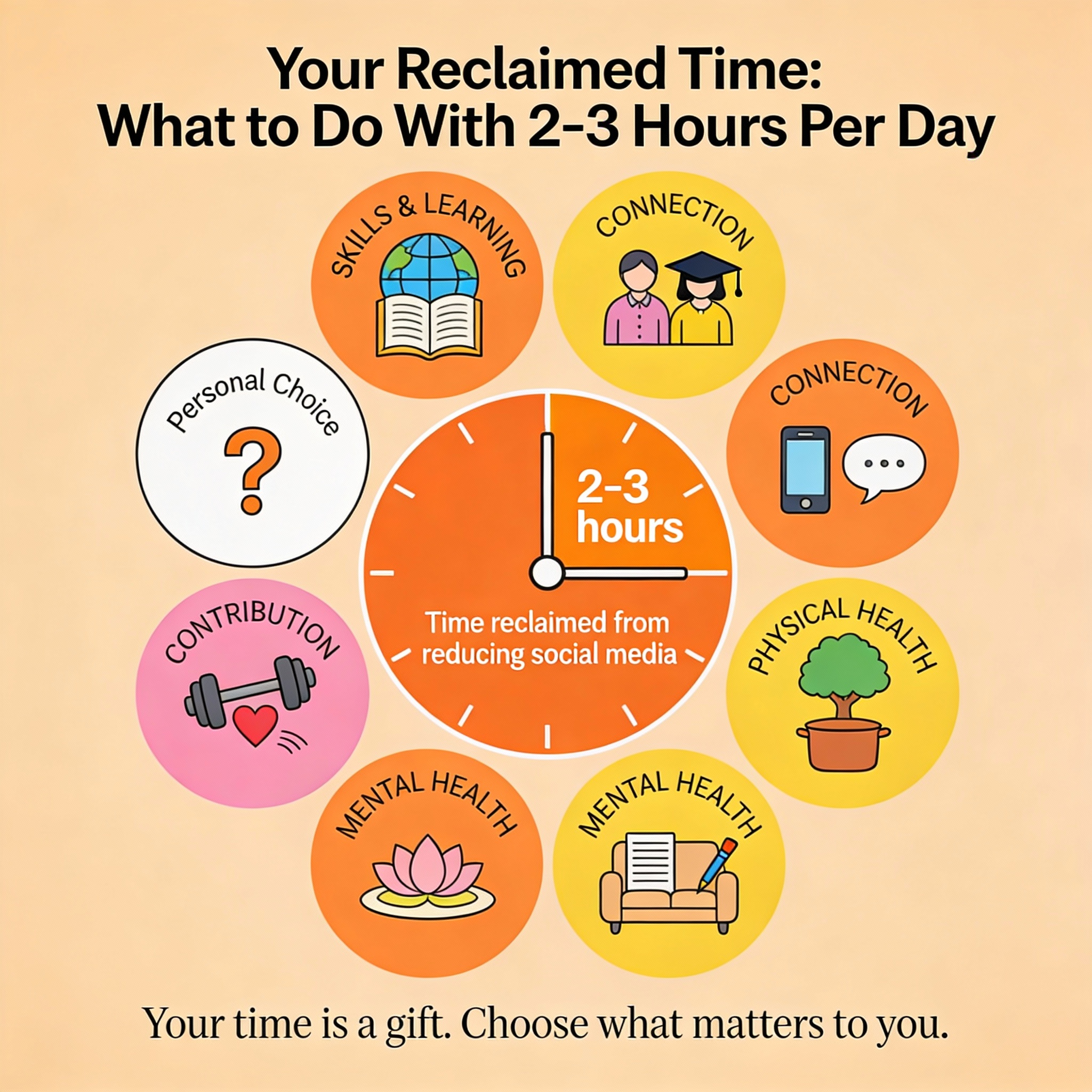
Purposeful use of reclaimed time:
Skills and learning:
- Learn something you've always wanted to (language, instrument, skill)
- Read (books, not articles)
- Take an online course or in-person class
- Work on a creative project
Connection:
- Spend time with people you love
- Call someone
- Write letters to people
- Have deeper conversations
Physical health:
- Exercise regularly
- Get outside
- Sleep better (phone-free evenings = better sleep)
- Cook healthy meals
Mental health:
- Meditate or practice stillness
- Journal
- Therapy (if needed)
- Yoga or breathwork
Contribution:
- Volunteer
- Help someone
- Work on something meaningful
- Create something
The key: these activities shouldn't feel like punishment. They should feel like reclamation. You're not sacrificing, but choosing what actually matters to you.
Relapse Prevention & Long-Term Maintenance
Most people can reduce social media for 30 days. The challenge is sustaining change beyond that.
Why does relapse happen?
Stress: When life gets hard, you return to old coping mechanisms
Social pressure: Everyone else is on it, you feel left out
Boredom: After the initial motivation fades
Gradual creep: You allow a little, then a little more, then you're back to baseline
Meaning loss: If you haven't built meaningful alternatives, the void pulls you back
Preventing relapse:
1. Keep your systems in place
- Don't think "I'm cured, I can have the app back."
- Keep friction (apps in folders, notifications off, time limits active)
- This is like keeping a gym membership after reaching fitness goals, even the maintenance matters
2. Build community around change
- Join groups of people reducing social media (r/nosurf, digital detox communities)
- Have accountability partners
- Regular check-ins
3. Monitor early warning signs
- Finding excuses to reinstall apps
- Increasing time on "allowed" social media
- Returning to phone checking when bored or anxious
- Feeling the familiar pull building
4. Have a relapse plan
- When (not if) you slip, have a specific response
- Immediately return to your strategies
- Don't spiral ("I failed, might as well give up")
- One binge doesn't mean relapse, but a return to the pattern does
5. Continue building the alternative life
- Your interests, relationships, hobbies, and goals should continue to develop
- Social media is only tempting if your real life feels empty
- A rich offline life is the best relapse prevention
The shift in identity
The most powerful relapse prevention is identity change. You're not "trying to use less social media." You're not "addicted." You're not "struggling."
You're someone who chooses presence over distraction. Someone who prioritizes real connection. Someone who values their attention and time. Someone who builds a meaningful life offline.
Identity is the strongest predictor of sustained behavior change. Become someone for whom social media is irrelevant, not through willpower, but through building a better life.
The Together With Kai Alternative
The deeper issue revealed by social media addiction is this: we're using it as a stand-in for what we actually need.
Social media promises connection but delivers dopamine hits. It promises community but delivers metrics. It promises belonging but delivers comparison.
Real connection requires:
Presence (people fully with you)
Vulnerability (your real self, not your curated self)
Depth (understanding, not broadcasting)
Continuity (relationships that deepen)
Reciprocity (mutual care, not performance)
Purpose (contributing to something together)
This is why intentional communities, mastermind groups, and relationship-focused platforms matter. Not as replacements for offline friendship, but as supplements that actually support real connection.
The goal isn't to quit social media and sit alone. It's to redirect your connection hunger toward genuine connection, both online and offline, that actually satisfies.
Conclusion: Your Attention Is Your Life
Here's the hardest truth: the technology companies are right about one thing. Your attention is valuable. Your time is precious.
The question is: who gets to decide how you spend it?
Every hour on social media is an hour not spent on what matters to you. Every dopamine hit from notifications is a moment of your life spent optimizing metrics that don't represent anything real.
The 30-day challenge isn't punishment. It's reclamation.
It's taking back what's yours.